| | | | | |
Nvidia's open Nemotron models are at an inflection point where they're likely to be the most dominant AI tools for enterprises. Simply put, you'll either tailor Nemotron models on your own or consume them via your enterprise software vendor.
Yes, we all know about Anthropic and OpenAI with closed models. How can you not? The frontier AI labs are too busy talking about AI regulation and the end of humanity to be useful. For the enterprise, you have more pressing concerns like returns, budgets and efficiency.
This backdrop is why Nemotron is accelerating. Nvidia's open models aren't the best, but they're good enough for most use cases and tasks. And, with tuning, Nemotron models are cheaper, give you control and more accurate. Nvidia's greatest skill is seeing around corners and sticking with open models when few in the US did is just another example. Here are some recent vignettes that highlight how the enterprise gravitated toward Nvidia Nemotron.
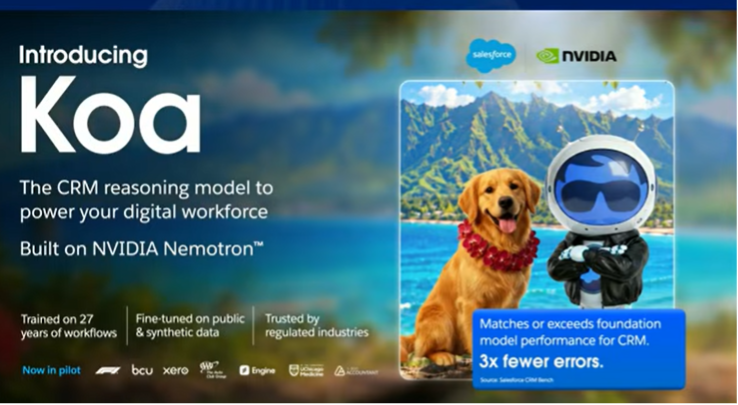
Salesforce launched Koa, a model built on Nvidia Nemotron 3 Super and leverages decades of synthetic data on workflows, processes and the moving parts inside of the Salesforce platform.
The company said Koa was measured in Salesforce's CRM Bench, which benchmarks CRM use cases and tasks, and found Koa matched or exceeded performance compared to leading models with 3x fewer errors. Salesforce controls the model weights and performed post-training inference within its trust boundary. | | | | Nvidia CEO Jensen Huang, riffing with Salesforce CEO Marc Benioff at Dreamforce 2026, said: "We see a future where the world uses closed models, but every company would also be able to build their own private models, your own customized models, which is the work that we're doing with you guys."
Huang could have just as easily say that Nemotron will be embedded in every enterprise software provider because their margins depend on open models working in conjunction with pricier frontier models.
Salesforce's Koa model will be replicated by every SaaS vendor. Why? These vendors have data on every implementation and process used by enterprises. The data may not be perfect, but synthetic data can close the gaps. Rest assured that ServiceNow, which has small language models and a Nvidia partnership that includes Nemotron, Workday and others will start touting their own models. The data over decades from ServiceNow and Workday tell you how enterprises run in practice.
And this Nemotron love affair will move across the enterprise software stack. DocuSign understands contracts and its Intelligent Agreement Management (IAM) platform could integrate open models. Box, an expert on document management, will do something similar. Until there are more US open models that are enterprise friendly, the game is Nvidia Nemotron's to lose.
| | | |
Palantir is driving Nemotron in the enterprise. At AIPCon 11, Palantir's customer showcase, there was a heavy dose of Nemotron and what CEO Alex Karp calls sovereign AI. The general idea is that the enterprise should control their differentiating data or your alpha. Karp has ranted about frontier AI labs repeatedly and in many respects is talking up Palantir's ontology and data game.
Nevertheless, it's hard to argue with Palantir's results. Meanwhile, SaaS vendors are cribbing whatever they can from Palantir whether it's ontology talk, forward deployed engineers and the importance of open models.
At AIPCon, Palantir and Nvidia stepped up their Nemotron efforts. The partnership, which was recently announced, is starting to scale and so is Nemotron usage.
Heidi Wood, Chief Digital and Transformation Officer of L3 Harris, said at AIPCon 11 that the company is starting to leverage open models. L3 Harris has been a Palantir customer for years and runs on its data ontology. Nemotron is starting to ride shotgun.
Wood said: "We believe American defense companies should not be a vassal for frontier AI labs, handing over our data and institutional knowledge, hoping to rent back the intelligence it creates. So we recently ran an experiment. We have an AI workflow that helps us monitor a country of origin for all the parts that we receive. Previously, we've relied on frontier models, and they've worked fine. But when we fine-tune open models trained on our own data, we were able to outperform the frontier models in less than 48 hours. The cost of our fine-tuned open-source model was 95% lower than the frontier models we were using."
She added: "AI is a commodity; it's all about the data. We view our data as a corporate asset. We have decades of data. Our data is a massive competitive differentiator. Using our data in our own ontology, in our own sovereign AI, that's next-level discriminator. We own the model. We own the compute, we own the advantage.
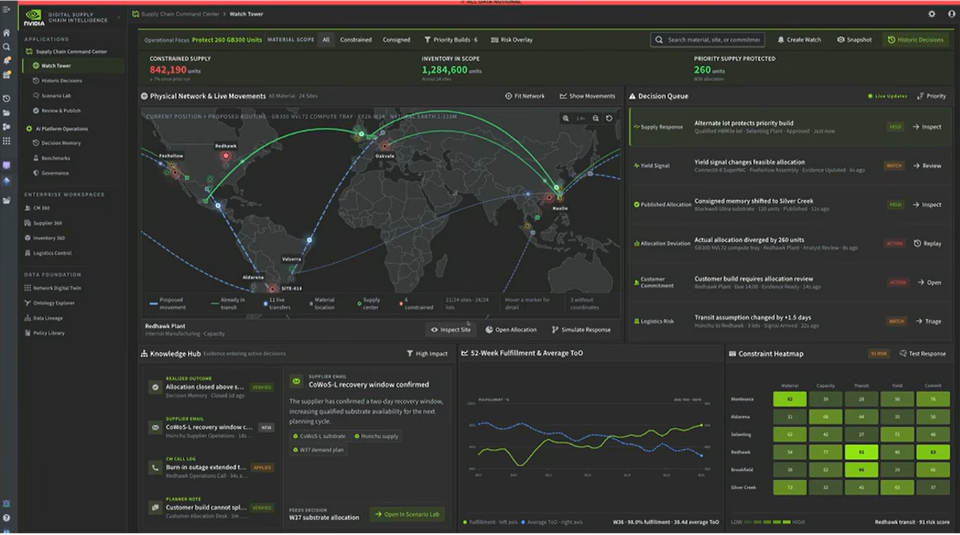
Nvidia's supply chain usage of Nemotron and Palantir. I'm not a huge fan of customer zero case studies, but Nvidia's use of Nemotron open models with Palantir Foundry and Artificial Intelligence Platform (AIP) as well as Palantir Ontology is worth noting.
Alex Neefus, Nvidia’s Senior Director of Solution Architecture, said at AIPCon 11 that the company is optimizing its supply chain, the most important one in the AI economy, using its open models.
"We want to optimize not just production volume, but we want to minimize the amount of time that those critical components are sitting waiting for other material to show up before we can build those boards," said Neefus. | | | |
Nvidia post trained its small Nemotron 3.5 Lightning model for lower cost and faster retraining. "A small-purpose-trained model will outperform the predictive correctness of the biggest model, one that's 10, 20 times bigger," said Neefus. "We can retrain this model on just a single GPU in a couple of hours. This lowers the bar, meaning that we can be retraining more and more often, really as often as we like, weekly, nightly."
Nvidia is running its supply chain optimization efforts on premises for security and safety. These use cases for Nemotron models are likely to proliferate. Stay tuned.
Synthetic data is also at an inflection point
The Nvidia supply chain use case as well as Salesforce's Koa launch featured mentions of synthetic data. Toss in Qualtrics' recent launch, which featured synthetic customer modeling and you have an emerging trend.
Synthetic data refers to information that's artificially generated by algorithms instead of collected from real-world events. Synthetic data mimics statistical properties of real data but doesn't have personal identifiable data about real people.
There are handy synthetic data primers from SAS, ServiceNow and IBM.
Given real supply chain data was sparse and sensitive, Nvidia used NeMo Data Designer to generate synthetic and anonymized data to bootstrap model training while preserving signal. "What it lets us do is take one week’s worth of sample information and make that look like months’ worth of samples," said Neefus.
As for the Salesforce Koa launch, the CRM vendor said it used synthetic data to train its latest model. For starters, Koa wasn't trained using customer data.
And it's likely that Salesforce's data over last 27 years had gaps. Leveraging synthetic data enabled it to fill in those data gaps. With Koa, Salesforce is looking to harness enterprise processes, workflows and policies and encapsulate them in a model.
Koa is built on scenarios for multiple CRM use cases including generating leads to resolving service issues across multiple industries. Each scenario is paired with a persona and tasks that need to be completed.
The idea is that Koa can improve further with an enterprise's data and context.
Synthetic data has been largely an academic topic until recently. Most enterprises will start using synthetic data to smooth over dirty data and make sense of their most valuable asset.
Observations - Salesforce laid out some heady growth projections and plans for monetizing AI. Short version: Salesforce’s pricing choices are a feature not a bug. There will be a healthy tension between Salesforce’s growth plans and customer negotiations over time. For now, you’ll probably make out because Salesforce wants the upgrades.
- The handwringing over AI regulation has reached a fever pitch, but let’s focus on who isn’t yapping: Amazon/AWS and Google Cloud. Anthropic is begging for regulation, OpenAI has a more nuanced view and Nvidia’s Huang and Meta CEO Mark Zuckerberg said the concerns about AI alignment boil down to making sure your products are up to snuff. You’re not hearing much from AWS and Google Cloud because there’s no upside and they have better things to do. And the answer for now is fairly obvious. “Run as fast as you can, but if you feel at any given point the product's not going to be safe, take a pause and make sure you get it right,” said Huang. See: Five Common Sense AI Regulations
- OpenAI CEO Sam Altman is misunderstood (just ask him). In a Dreamforce interview with Salesforce CEO Marc Benioff, Altman was asked about the regulation banter. “The world should trust that we are going to do the right thing, because it's the right thing, and because we feel the magnitude of this,” said Altman. Here’s OpenAI’s first downpayment on earning trust: OpenAI's new misalignment disclosure framework a solid start
- Essay of the week goes to Microsoft AI CEO Mustafa Suleyman, who argued that AIs do not have rights, feelings, or consciousness. And we must not train them to act as though they do. Related: Microsoft’s Code of Conduct for its AI models.
- Given all the AI regulation talk and security worries, here’s an idea worth pondering: Treat all AI agents like insider threats. Here’s an interview with Dr. Allen Badeau Jr., Chief AI Officer at DigitalNet.ai, to talk about securing AI agents.
- Matthew McConaughey is the voice of Salesforce and introduces Benioff during keynotes and interviews. Instead of giving various AI agents prep school names like Hunter and Piper, I’d argue they should just make McConaughey the voice of every Agentforce agent and include one of his inspirational quotes each day.
| | | | Notebook
📒 For the latest, see Constellation Insights and Notebook.
🫱🏽🫲🏾 Cohere and Aleph Alpha signed their merger agreement officially and said they will remain deeply rooted in Canada and Germany. The new company is focused on sovereign AI and being a transatlantic counterweight to US frontier AI labs. The company will operate globally as Cohere. See: Cohere acquires Aleph Alpha to form US AI counterweight
⚡ Generac said it has inked a deal with Amazon for backup power at its data centers. Under the deal, Amazon will have the option to acquire nearly 1.7 million shares of Generac at $200.9266. Generac will provide up to $8 billion in backup power generators. Initial deliveries of backup generators are expected to total $2.4 billion in 2027 and 2028.
🤖 HubSpot launched an all new Breeze Assistant that maintains context from its new CRM system. The new Breeze Assistant, built on its new Smart CRM, was announced at HubSpot's Unbound conference. Breeze Assistant takes action, assigns tasks to agents and delivers proposals, reports and campaign plans with context.
💰 AI agents are having their moment and forcing CxOs to think through pricing models, where SaaS stands, cybersecurity and enterprise organizational design.
📝 Anthropic merged Claude chat and Cowork and added new tools for making presentations and documents. The company rolled out Claude Docs and Claude Slides and Claude Design now works inside conversations. The company said it will roll the updates to Pro and Max plans first and then other accounts.
🍎 According to The Information, Apple has been working on plans for an enterprise server using its own chips that could incorporate networking equipment from Nvidia. The move makes some sense given Apple's popularity with AI developers.
📊 OpenRouter said its users spent more on OpenAI models over Anthropic's models. OpenAI hasn't led Anthropic on OpenRouter for 2.5 years.
🛡️ Meta CEO Mark Zuckerberg penned a missive on AI regulation that boiled down to this: Frontier labs need to get it together. In an X post that Zuckerberg said: "Meta delayed shipping Muse for several months to focus on safety and security. We didn't call for everyone else to do this before we would. We just did it as part of our day-to-day work because it was clearly the right thing for people and for us."
🚨 Amazon Web Services said it can't restore services to its cloud facilities in Bahrain and parts of the UAE. The data centers were hit in the US-Iran war in March.
🎙️ Google launched Gemini 3.8 Live and 3.8 Live Extended Thinking, which represent the company's most advanced live dialogue models. The upgrades are designed to make it easier to collaborate and carry out advanced tasks with voice.
🔐 An EY survey found that 47% of enterprises have not applied its AI governance processes for urgent deployments even though 98% of them have policies in place. In addition, EYU found that agentic AI is creating new governance challenges with 26% of respondents saying they can't detect unauthorized agents operating internally. | | | |
Insights Archive Salesforce still has pricing work to do Why you should arbitrage your AI models like your vendors do Quantum computing: Where we stand in 2026 SaaS: Apocalypse over, sorting winners and losers just starting Why AI infrastructure folks are talking so much about applications AI value metrics and vendors need better pricing models Enterprise AI grows up, vendors are noticing How UnitedHealth Group sets its AI stack, targets 1,000 use cases Enterprise vendor pecking order will be upended by volatility, AI inflection points Here’s what we learned about AI projects from enterprise buyers so far Here’s what we learned about AI projects from enterprise buyers so far Don't let your vendor's AI strategy become yours For Starbucks, AI returns are behind the scenes What if our AI infrastructure is already built? How to avoid vendor lock-in in the AI age AI inference costs will be a major concern: What's the fix? How Prudential CTO Liz Brand is approaching agentic AI, transformation The private preview plague Google Cloud, AWS, Microsoft Azure: The AI vertical integration race How Verizon manages AI agent sprawl The space race and what it means for enterprises Google Cloud Next 2026: A look at the big themes Your AI talent planning algorithm is common sense Zillow bets on content, context, data flywheel as AI differentiator AI Forum 2026: There isn’t an easy button for AI Constellation Research's Futures Forum: What CEOs are thinking Where’s tokenomics for the rest of us?
Disruption coming for ERP and not from where you'd think
Anthropic vs. SaaS: A nuanced view
Zoho Day 2026 themes to watch: ERP, SaaS, customer value, AI, sovereignty
How three hotel giants are playing agentic commerce, AI
SaaS under the microscope: How to evaluate your vendor Forward-deployed engineers: The promise, peril in AI deployments Caterpillar’s AI Vision Takes Shape, but Data, Cloud Focus Was the Precursor Agentic AI experiences will determine enterprise winners Why enterprise AI leaders need to bank on open-source LLMs -
Enterprise technology 2026: 15 AI, SaaS, data, business trends to watch
| | | | | | | | | | | |