| | | | | |
There isn’t an easy button for agentic AI and enterprises will need more discipline to implement it, not less. The difference between AI transformation and real returns is dependent on whether you do all the hard stuff such as process optimization, change management, workflows and architecture right. In the meantime, we're going to see some great experimentation and potential trainwrecks with OpenClaw, AI agents that run amok and billions of dollars spent chasing that AI easy button.
The myth of the AI easy button is top down in the tech industry. To hit AI nirvana, all you have to do is spend $100 billion on an AI factory that depreciates after a year, generate tokens that miraculously turn to revenue and watch the magic happen. Simple right? Enterprises will then chase whatever agentic AI and digital labor fad promises utopia. It's OpenClaw today (or any of its derivatives) and whatever Claude feature from Anthropic blows up the SaaS market (again). And tomorrow, who knows?
AI will surely create winners and losers, but my bet is that the companies that can execute and do the hard stuff with discipline will win. The rest of the field will merely deliver exponential growth in token budgets with little to show for it. | | | |
Constellation Research's Futures Forum and AI Forum were illuminating. We've covered the takeaways from the Futures Forum and discussion that ensued among CEOs. This latest riff on the hard work of AI was inspired by a LinkedIn post from Gurvinder Sahni, CMO of Altimetrik.
At AI Forum, the CxOs that are tasked with executing plans from the CEOs at Future Forum had their say. Here's a look at the takeaways from AI Forum on the hard stuff.
Context, orchestration and architecture are the bottlenecks for AI and agents not just models. Enterprises need to focus on the business logic and deterministic workflows more than non-deterministic agents that'll allegedly just figure it out.
For orchestration, the prerequisites are safe, governed and observable orchestration. LightHorse Enterprises Founder Colt McNealy said orchestration shouldn't be based on a "YOLO" approach. "The only reason you give agents that much room to run is because you don't have the proper infrastructure to run automation on your own," said McNealy. "In a couple of years, we'll be seeing people get their affairs in order to fix YOLO security."
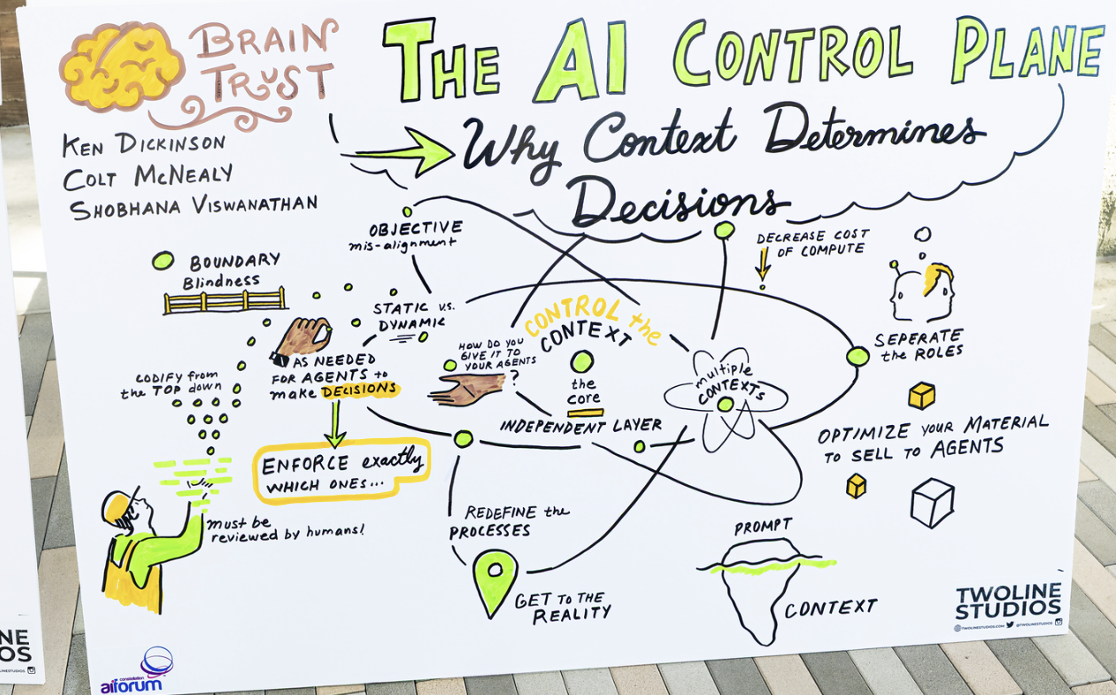
The AI control plane needs to be infused with context that can improve agent accuracy and enable them to scale.
See: AI Forum 2026: "There are claws everywhere now" | Littlehorse’s McNealy on Business-as-Code, AI agents, orchestration
All of the hard work enterprises have been avoiding such as collapsing data silos, access control and murky process maps are haunting companies in the AI era. | | | | "To have a successful agentic solution, you need to understand the overlying rule set, which is your actual context, so that you can make the correct decisions," said Ken Dickinson, VP of Software Engineering for Jewelers’ Mutual.
To sum up. Your agentic architecture needs: - Clear business workflows.
- A strong orchestration layers
- Narrow decision surfaces instead of open-ended agent autonomy.
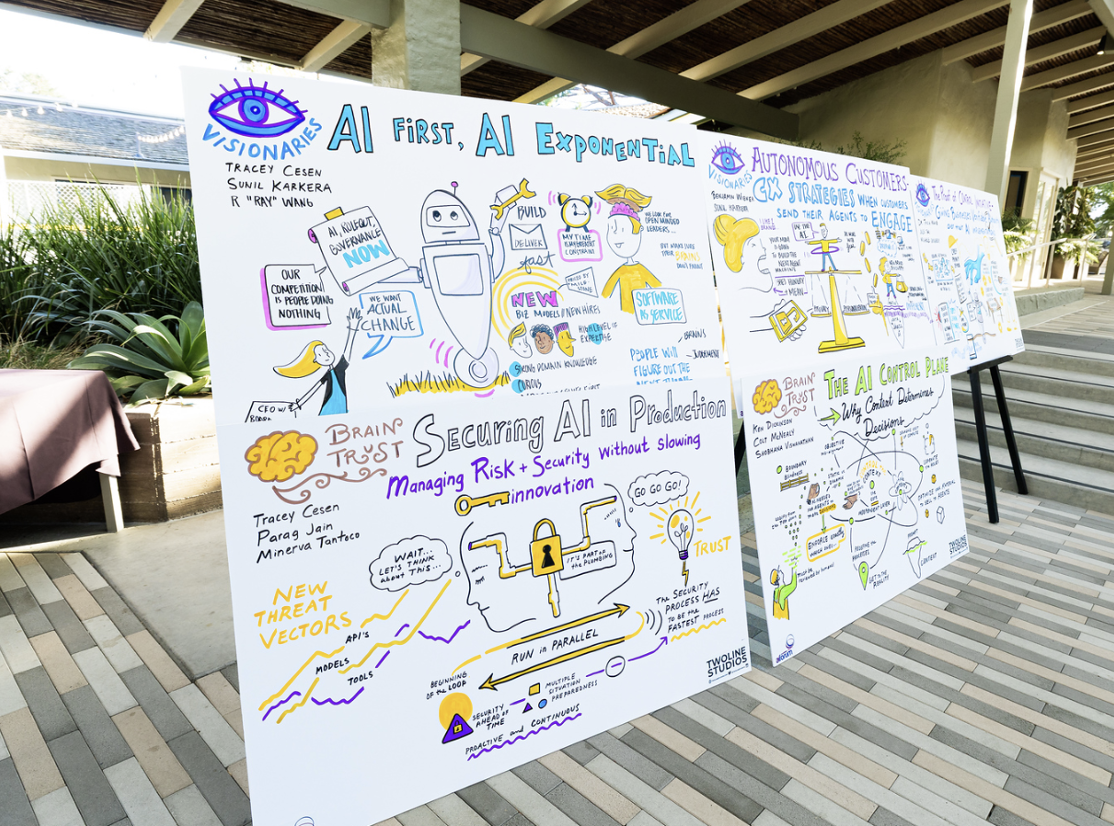
Enterprise AI in production revolves around security, guardrails and proof of control.
Multiple panels stressed security and risk procedures from day one not as an afterthought.
That means: - Weekly "what could go wrong?" reviews.
- Security practices with continuous monitoring.
- Accountability.
- And proof of control. One session at AI Forum proposed proof of control as an emerging standard.
Proof of control standards, an emerging field, are framed by deterministic controls on non-deterministic AI and cryptographic independently verifiable proofs that systems behaved as intended. Michelle Dennedy, CEO of Stealthy Privacy and Partner of Privatus.Online, said:
"I'm looking at the agentic world today. If you have something of value, you have to know what it is. You have to know what its boundaries are, and you have to know how to demarcate and have some accountability and agency so that you can turn what is potentially an asset and prevent it from sliding into being a liability."
Digital labor will disrupt business models.
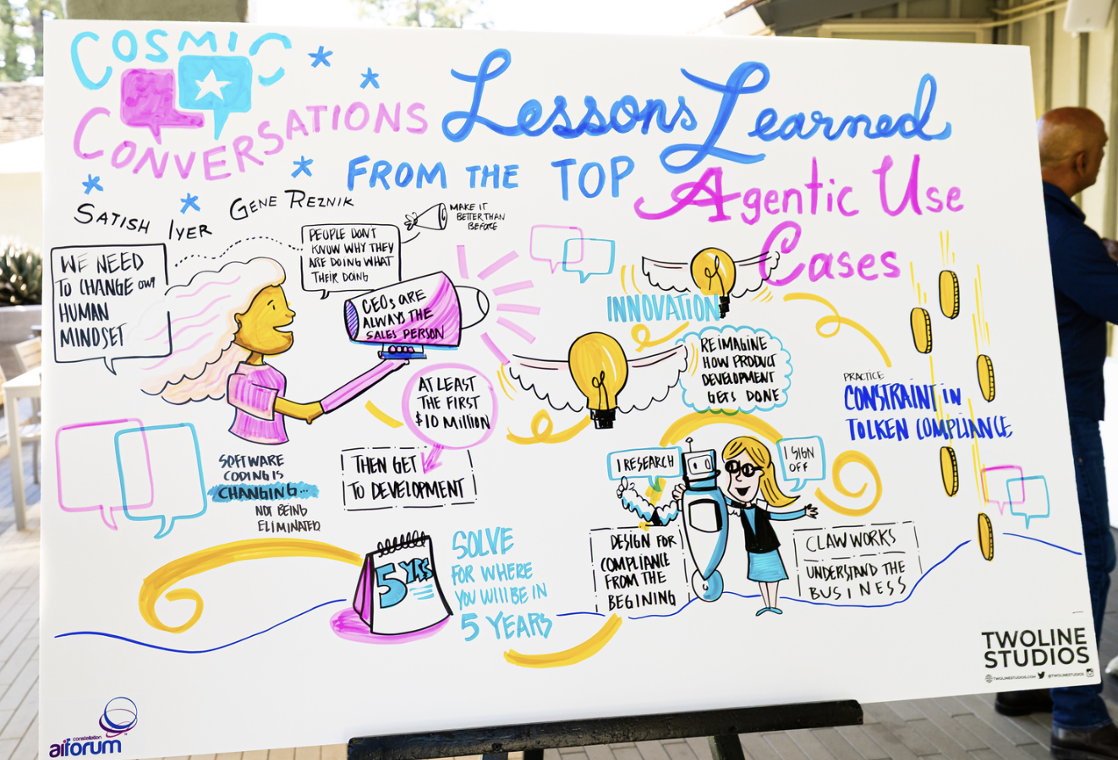
The narrative for digital labor is appealing for companies due to cost savings. Humans are simply more expensive. However, business models will need to be redesigned as agentic AI labor grows. That means the following: - Compliance and oversight of AI agents will be required.
- Standardized management, identity and security will be needed for fleets of AI agents.
- Orchestration of work will be critical.
- Where do you keep humans in the loop?
- What are the new models for management and skills required to delegate to AI agents?
See: Thoughtworks data, AI chief Mohanty on how agentic AI will change leadership | Scenes from two AI-native services firms
Digital labor is also moving from experiment to operating model. The economics of digital labor revolve around revenue per employee and outcomes and require new organizational designs. | | | | Data is still your biggest problem.
At AI Forum, there wasn't one AI discussion that didn't include data quality and governance. See: CX strategies for agentic AI | Actian CEO Potter: AI driving a data governance renaissance
AI is forcing CxOs to get their data act together. CxOs need to: - Understand data lineage, ownership and context.
- Discover, tag and map critical data before scaling AI.
- And take on a data as product approach that features clear consumers and contracts.
- Data-in-motion is the norm over dashboards.
- If the data strategy isn't right, you're just going to automate and scale bad processes.
Who is leading AI and the organizational change that goes with it?
Like Futures Forum, AI Forum attendees seemed to agree that the CEO's neck was on the line if the AI strategy wasn't right. The actual work in the trenches will belong to others.
Execution will depend on chief information officers, chief AI officers and dozens of business domain experts. New leadership skills will be required. Key points: - Curiosity was frequently cited as an underrated leadership trait.
- CxOs in place today will be the last to manage all-human workforces. Leaders will need to manage human and digital workforces, rebalance roles and think through governance.
- Enterprises will need to invest in training, domain expertise and design thinking to get value.
Anil Cheriyan, Board Member at the Center for Astrophysics | Harvard & Smithsonian, said he has five questions when it comes to AI leadership.
"The questions that I ask whenever we're talking about AI is 1) what is the real business value that you're going to generate? 2) how are you managing risk, risk and governance? 3) Do you have the talent? What's AI going to do to the talent? What's it going to do for the human AI interface? 4) Do you have the data? 5) Do you have the money to do what you need to do?" | | | | Cheriyan added: "All of those five tings require pretty much everyone in the business to manage. You need the chief businesspeople to drive value. You need the risk folks to drive governance. You need the coordination piece."
On a panel about AI accountability, Minerva Tantoco, CEO of City Strategies LLC, summed it up: "I'd like to see what each of the C-suite thinks they can do today that they could not have done two years ago. Then give me their vision for what they like to do with the new capabilities." | | | |
NOTEBOOK
📓 For the latest on Constellation Research’s AI Forum and breaking news see Constellation Insights and my live Notebook.
👾 Google has hedged its bets on quantum computing and said it will expand its research into neutral atoms while maintaining its focus on superconductors. In addition, Google said it moved up its timeline for post-quantum cryptography (PQC) migration to 2029 due to quantum computing advances.
🧲 IBM said its quantum computer can simulate magnetic materials. The company said that the breakthrough can lead to new materials. The simulaton, outlined in a paper, was conducted by scientists from the U.S. Department of Energy-funded Quantum Science Center at Oak Ridge National Laboratory, Purdue University, University of Illinois Urbana-Champaign, Los Alamos National Laboratory, the University of Tennessee and IBM.
🚀 Databricks launched Lakewatch, an agentic AI powered SIEM (Security Information and Event Management) system, which aims to unify security, TI and business data in one environment. Also: Elastic Security bets on native Workflows, data-centric approach | RSAC 2026: Everyone trying to secure AI agents, various 'claws'
♾️ Google Research outlines algorithms that may ease AI memory squeeze. Google Research said it has created a set of algorithms that could reduce the need for a massive amount of memory for AI workloads.
📢 Arm is best-known as a chip designer, but the company recently announced plans for its own AI chip for inference. Arm said it landed OpenAI and Meta as customers for its AGI CPU. The AGI CPU is built on Arm's Neoverse architecture, which is already used in AWS Graviton, Google Axion, Microsoft Cobalt and Nvidia Vera. Arm's AGI CPU already has a bevy of launch partners.
🚀 Monday.com's agent lab launched Agentalent.ai, a marketplace where customers can hire AI agents for business roles.
🤝 Infosys has acquired two companies. Infosys said it acquired Stratus, a technology services provider for the property & casualty insurance industry. Stratus is a leading Guidewire Software partner. In a separate announcement, Infosys said it has acquired Optimum Healthcare IT, which is a partner for ServiceNow, AWS, Workday and Microsoft Azure.
🔀 Oracle said it has added a set of agentic AI features to Oracle AI Database in a move that brings autonomous agents closer to transactional data. Separately, Oracle announced new agentic AI capabilities to its Fusion Cloud applications.
⏱️ Accenture said AI projects lead to data projects half the time, enterprises with strong digital cores are expanding AI initiatives and companies are looking to transform their SaaS implementations.
🚀 HP launched HP IQ, a local AI layer, which will be built into HP AI PCs and workplace devices. HP IQ will be able to connect with other HP devices to collaborate.
🌉 Miro said it will acquire Reforge, which is an AI platform for product teams, in that aims to bridge product development and frameworks with AI-driven collaborative workflows. Andrey Khusid, CEO of Miro, said in a statement that the deal is aimed at helping customers innovate faster by focusing on what to build as well as the how.
🍎 Apple said its annual Worldwide Developers Conference (WWDC) will be online from June 8-12. Apple will hold an in-person event during the keynote and state of the platform address June 8. | | | | | |
Insights Archive Constellation Research's Futures Forum: What CEOs are thinking Where’s tokenomics for the rest of us?
Disruption coming for ERP and not from where you'd think
Anthropic vs. SaaS: A nuanced view
Zoho Day 2026 themes to watch: ERP, SaaS, customer value, AI, sovereignty
How three hotel giants are playing agentic commerce, AI
SaaS under the microscope: How to evaluate your vendor Forward-deployed engineers: The promise, peril in AI deployments Caterpillar’s AI Vision Takes Shape, but Data, Cloud Focus Was the Precursor Agentic AI experiences will determine enterprise winners Why enterprise AI leaders need to bank on open-source LLMs -
Enterprise technology 2026: 15 AI, SaaS, data, business trends to watch - 2025 in review: AI trends from the buy side and sell side
- Rimini Street’s second act will include heavy dose of agentic AI, UX
- AWS re:Invent 2025: This one was different
- The enterprise LLM questions you should be asking
- Frontline workers get their AI moment
- A look at the intersection of AI and customer experience
- AGI may be far away, but 'jagged AI' will still take jobs
- CCE 2025: AI agents: Dreams, reality and what's next
- OpenAI, Anthropic increasingly diverge as strategies evolve
- Welcome to the context chorus: There’s no AI without context
| | | | | | | | | | | |