| | | | | |
Industrial companies, the ones that actually make stuff and keep the economy moving, are worth watching to see how they leverage AI. The industrial AI approach is decidedly practical, grounded in business reality and returns, and designed to augment scarce human labor. You could call it blue-collar AI.
After spending a week at IFS Unleashed 2026, this blue-collar AI theme is worth watching. Industrial AI is one reason to be optimistic about enterprise AI, even as bubble fears dominate AI infrastructure chatter.
Here's a look at some of the AI themes from industrial companies.
The opportunity. IFS CEO Mark Moffat noted during his keynote that industrial companies use only 40% of their data. As a result, industrial operations run at about 60% of their potential, which means more unplanned downtime, productivity gaps, and unused expertise.
Moffat added that frontline workers only spend a third of their time with a tool in hand. The rest of the time is waiting, searching, and filling in forms.
Add it up, and the industrial sector is one area where AI, process, and domain knowledge can converge to drive returns.
Business case is priority because planning cycles are short and capital isn't infinite. Stratus CEO Bill Hayden said AI investments are selected based on return on investment, complexity, and change management. Stratus, which builds and maintains signs and interior branding for large national brands, needs to think through the business case and timing because the planning cycles are compressed.
As an early customer of IFS Intelligence, the company now revolves around short planning cycles. "We're now thinking in like three months, 12 months max," said Hayden. "I have no idea what five years looks like."
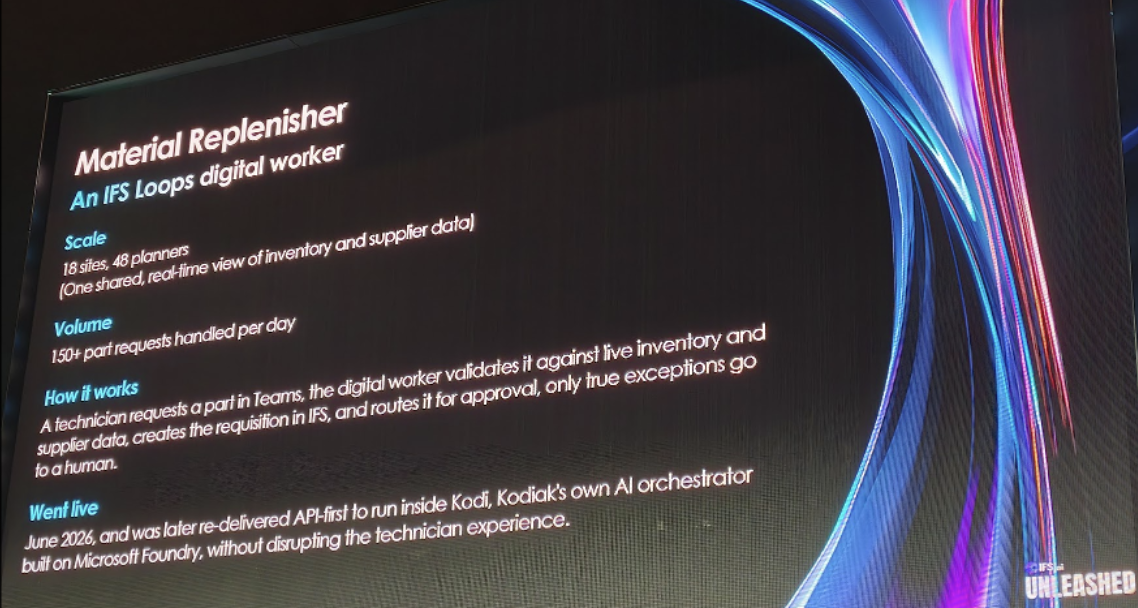
Real returns. Multiple companies outlined returns based on money and time saved. William Grant & Sons, a distillery, cut a report migration from 200 days to 30 minutes. EightGroup cut the time to conduct an electrical inspection from 25 minutes to 60 seconds. Kodiak Gas' Material Replenisher, a digital worker that identifies parts for an asset, locates them in inventory, and procures them if needed, showed an 85% efficiency gain for transactions processed via the AI agent. Preventative maintenance was frequently cited as an AI use case. "We need to move more from a reactive to a proactive and a predictive mindset, and getting a holistic approach to assets is critical in our journey. The second one is spare parts. Getting the right spare part at the right site at the right level is critical to operations. Too much access ties up working capital, and fewer spare parts cause stockouts and downtime," said Chetan Balsara, CEO of Covia Corp. | | | |
Industrial AI use cases were also a welcome change for this scribe, who is frequently pelted with buzzword-laden slides, vaporware, new models that are .0001 better on a largely meaningless benchmark, and questionable capital deployment.
Chamath Palihapitiya, CEO of Social Capital | 8090, said: "I don't think that we have seen the investment returns that people have expected for the amount of money that people have spent in AI. It's a tale of two worlds. It's a lot of forward investment, speculatively building unbelievable enterprise value, but we don't know if that's really sustainable. And on the other side, real companies trying to figure out how to do it in a proper, responsible way."
The returns outlined at IFS Unleashed were from form-heavy workflows: procurement, parts sourcing, inspections, data fixes, and training. Those projects went live in weeks, not years. One metric that was tied to field service was first-time fixes.
AI isn't replacing labor as much as it’s filling a shortage. Multiple IFS customers said AI use cases focused on training new workers, replacing retiring technicians, and offloading tasks that sap productivity.
Lauren Purcell, aircraft engineering manager at UPS, said the industry doesn't have the labor capacity to support the rate it's going. "In terms of workforce, we just can't keep up with the training to replace those that are leaving the industry and that are retiring," said Purcell. "We're seeing retirements from these people that have been in the industry for so long and have years and years of knowledge just walk out the door, and we're working to better the training processes and more automated training processes." | | | | In a nutshell, industrial companies are pursuing people, plus AI strategies. AI can also raise new workers to expert level faster.
Employee satisfaction and retention are AI use cases. MD Akil, director of project management at Kodiak Gas, said the company can lose workers for only a few extra dollars an hour. "AI can improve the user experience and improve employee satisfaction scores. One of the biggest problems that we have in our industry is retention," said Akil. "Having ease of usability at hand in-house is a huge retention factor." | | | |
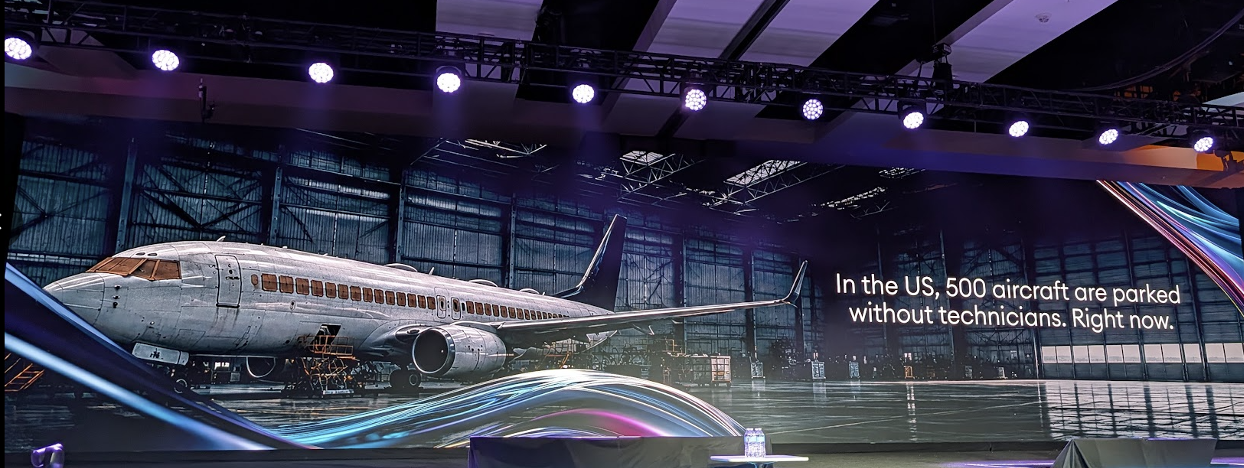
Retention is everything because the skilled labor shortage is real. Boeing expects the industry to need more than 700,000 maintenance technicians over the next 20 years, with two-thirds of that sum replacing retirees.
Domain knowledge and industry context are everything. Industrial executives weren't as focused on the latest, greatest models as they were on applying their industry domain knowledge to AI. Process is also critical. Building this context will be difficult, given how many people with institutional knowledge are retiring.
"The most important thing is to reconstruct the organizational hierarchy of a company. I think the big opportunity is for folks to embrace and really understand how you get the tribal knowledge in people's heads encoded so that it's machine-readable," Palihapitiya said.
Governance, safeguards, and trust are front and center. Governance was a core topic among industrial companies. AI will require safeguards and observability at every step. In industrial settings, you can't simply blame an AI agent for a bad outcome. Machines may take action, but you'll own the outcome.
Industrial companies realized they couldn't have a human sign off on every work order, but they still need to rank the risks. Human checks on automated systems for critical infrastructure make sense. Other processes will simply slow down processes that could be automated.
Industrial AI is a long game. Industrial customers at IFS weren't all on the cloud or the latest version of the platform. Some didn't have their data strategies down. Other customers were early adopters of AI models. While robots were plentiful on the show floor and around, most customers weren't thinking humanoid robots. Industrial AI will be built one use case at a time because capital isn't falling out of the sky.
| | | |
Observations
JPMorgan Chase executives were asked about the returns on the company’s AI spending. CFO Jeremy Barnum said he wasn’t going to quantify hard returns because AI is integrated throughout the organization. He also said: “I'm just very reluctant to spend a lot of energy quantifying it because it winds up wasting a lot of people's time inside the institution when we actually need to get them to focus on doing things." Barnum added that multiple AI use cases are “increasingly exciting.”
What remains to be seen is this: Will every company that misses earnings targets be asked about AI returns?
Meta has released Muse Wonder and Muse Wonder Full in what it calls its most advanced models yet for personal and professional agentic AI tasks. Muse Wonder is available for developers, and Muse Wonder Full is available for Muse Code subscribers. Muse Wonder will be the default model in Muse shortly. With Meta’s most advanced models released, we’ll see whether it can gain traction as a leading frontier AI lab. CEO Mark Zuckerberg and Chief AI Officer Alexandr Wang have Meta rolling. Is growth mindset key to AI returns? A report from Knowledge at Wharton, noted that companies with a growth mindset generate more returns from AI investments. Wharton said 35% of companies measuring AI against growth outcomes report strong ROI compared to 13% measuring AI on efficiency alone. Here’s a question to ponder after this report: Did companies overestimate AI's efficiency gains in the first place? | | | | Notebook
📒 For breaking news and insights, see Constellation Insights and Notebook.
🎛️ ServiceNow said it is updating its AI Control Tower with AI Passport, which uses the company's AI harness to provide governance, integration, and oversight. The effort builds on Nvidia's Open Agent Safety Platform initiative, which aims to put deterministic controls on AI agents to keep them from running amok. Also see: Microsoft CEO Nadella: Agentic AI needs healthy dose of deterministic controls
🚪 Workday made Sana the front door for its platform, launched Agent Harness, which lets enterprises build AI agents that run in isolated environments for finance and human resources data, and outlined ambient agents and tools for decision and work intelligence.
🫱🏽🫲🏾 Anthropic will acquihire Opaque, which has specialized in confidential computing and AI. Anthropic said in a research blog that small AI models may be months away from self-replicating on Internet of Things devices.
📢 UKG said it will go headless in bringing its UKG Workforce Operating Platform to AI interfaces from Anthropic, Google Gemini, OpenAI, and others.
🚀 Microsoft said it will launch its Azure Maia 300 processor in 2027 in multi-gigawatt data centers. When it scales, Microsoft's Azure Maia family of chips will be the go-to inference processor for Microsoft's products.
🔔 Big banks reported mixed third-quarter earnings. Here’s a look at the decks for Bank of America, JPMorgan Chase, Goldman Sachs and Morgan Stanley. BlackRock added for good measure.
📈 Goldman Sachs reported strong third-quarter earnings, and CEO David Solomon provided his take on AI infrastructure and capital. He said: "In our conversations with clients, demand for compute significantly exceeds supply at the moment, creating opportunities to help develop financing structures to meet that capacity shortfall.”
🤖 In a blog post, Google said Gemini 4 Argon is available for developers and enterprises. The company rolled out Gemini 4 Argon via the API in AI Studio and the Gemini platform, as well as to Google AI Ultra subscribers, Google Antigravity, and Google AI Ultra and Pro subscribers. The model will also be in AI Mode in Search and the Gemini app.
💲 An IBM Institute for Business Value has a few notable facts about consulting expectations in an AI-first world: "81% of executives say consulting services must change to remain relevant to their organization. Pricing is a top concern, with 68% of executives saying current delivery models are too costly and inefficient. As AI capabilities improve, business leaders expect more for less."
🧠 Here’s what I really think about the term super intelligence. | | | |
Insights Archive Data ontology: A kinder, gentler form of lock-in The great enterprise AI rewrite is starting Enterprise AI projects mature: What you need to know now Nvidia’s Nemotron hit enterprise AI inflection point Salesforce still has pricing work to do Why you should arbitrage your AI models like your vendors do Quantum computing: Where we stand in 2026 SaaS: Apocalypse over, sorting winners and losers just starting Why AI infrastructure folks are talking so much about applications AI value metrics and vendors need better pricing models Enterprise AI grows up, vendors are noticing How UnitedHealth Group sets its AI stack, targets 1,000 use cases Enterprise vendor pecking order will be upended by volatility, AI inflection points Here’s what we learned about AI projects from enterprise buyers so far Here’s what we learned about AI projects from enterprise buyers so far Don't let your vendor's AI strategy become yours For Starbucks, AI returns are behind the scenes What if our AI infrastructure is already built? How to avoid vendor lock-in in the AI age AI inference costs will be a major concern: What's the fix? How Prudential CTO Liz Brand is approaching agentic AI, transformation The private preview plague Google Cloud, AWS, Microsoft Azure: The AI vertical integration race How Verizon manages AI agent sprawl The space race and what it means for enterprises Google Cloud Next 2026: A look at the big themes Your AI talent planning algorithm is common sense Zillow bets on content, context, data flywheel as AI differentiator AI Forum 2026: There isn’t an easy button for AI Constellation Research's Futures Forum: What CEOs are thinking Where’s tokenomics for the rest of us?
Disruption coming for ERP and not from where you'd think
Anthropic vs. SaaS: A nuanced view
Zoho Day 2026 themes to watch: ERP, SaaS, customer value, AI, sovereignty
How three hotel giants are playing agentic commerce, AI
SaaS under the microscope: How to evaluate your vendor Forward-deployed engineers: The promise, peril in AI deployments Caterpillar’s AI Vision Takes Shape, but Data, Cloud Focus Was the Precursor Agentic AI experiences will determine enterprise winners Why enterprise AI leaders need to bank on open-source LLMs -
Enterprise technology 2026: 15 AI, SaaS, data, business trends to watch
| | | | | | | | | | | | | |