Print Icon
 

June 6, 2026

If you're one of those people who watch what people do, not what they say, you may want to start paying attention to AI royalty right now. Why? Because the likes of Microsoft CEO Satya Nadella and Nvidia CEO Jensen Huang are kicking it like it's the 1990s with PC upgrade cycles, CPUs, and on-premise infrastructure.


Yes, folks, we have a problem. Tokenomics only works for a handful of companies (maybe), and unless you take compute out of the cloud for AI inference, the economics won't make sense. Makes you wonder about all those FOMO driven dollars being spent on AI factories and a centralized compute model that may already be outdated.


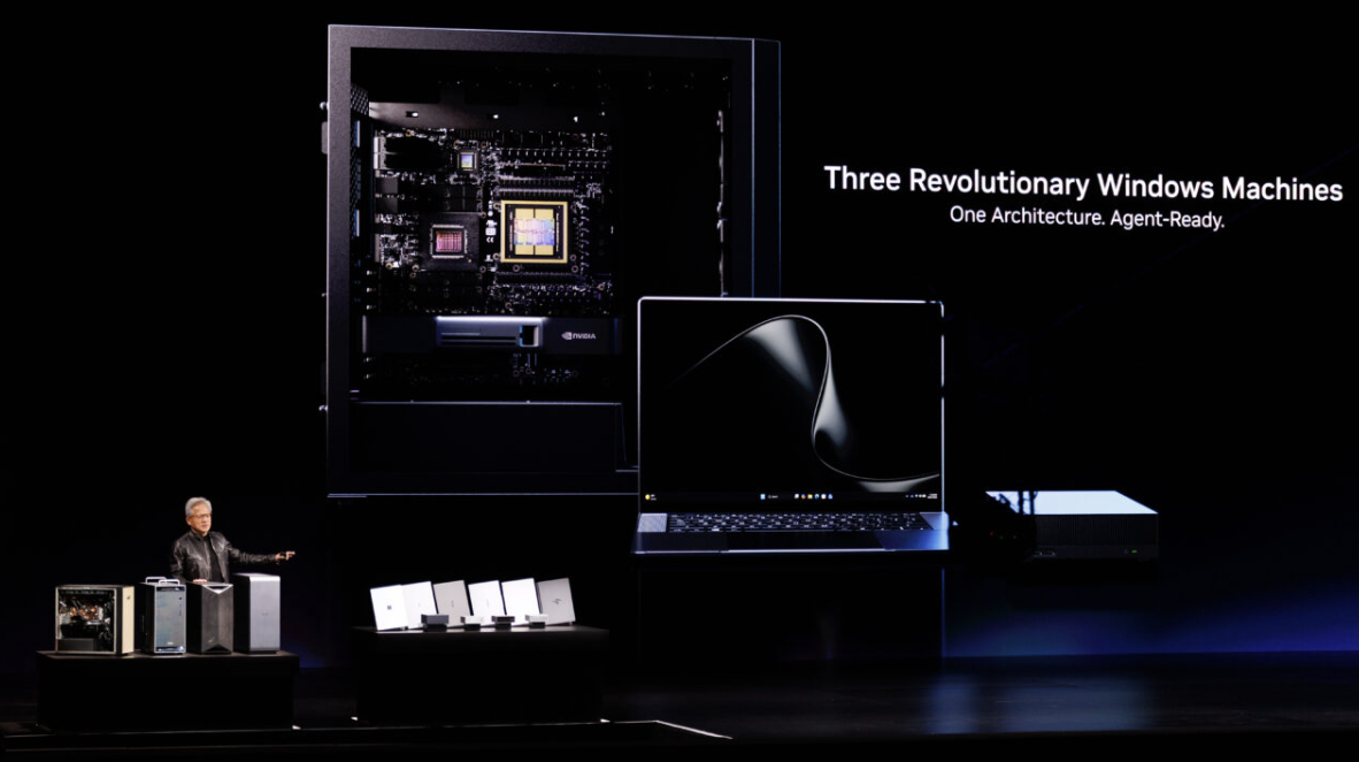
Nvidia's Huang kicked off with a Computex keynote that largely revolved around the CPU. Nvidia wants to be inside PCs and workstations with its Vera CPU. There's a reason for that: AI inference is all about the CPU. Huang also showed off a few PCs while he was at it.


Apparently, Nvidia wants to be the next Intel Inside even as it dominates GPUs and AI data centers. You could call Nvidia's move a nice hedge.


Nadella noticed: "When I saw that Jensen picture from the weekend, where he had all the desktops, I felt like, man, I'm back in the 90s. It was so cool to see the lineup of all the machines I loved and grew up with, back yet again with new functionality. The same form factor, but unbelievable new functionality, because of the onboard AI capability."

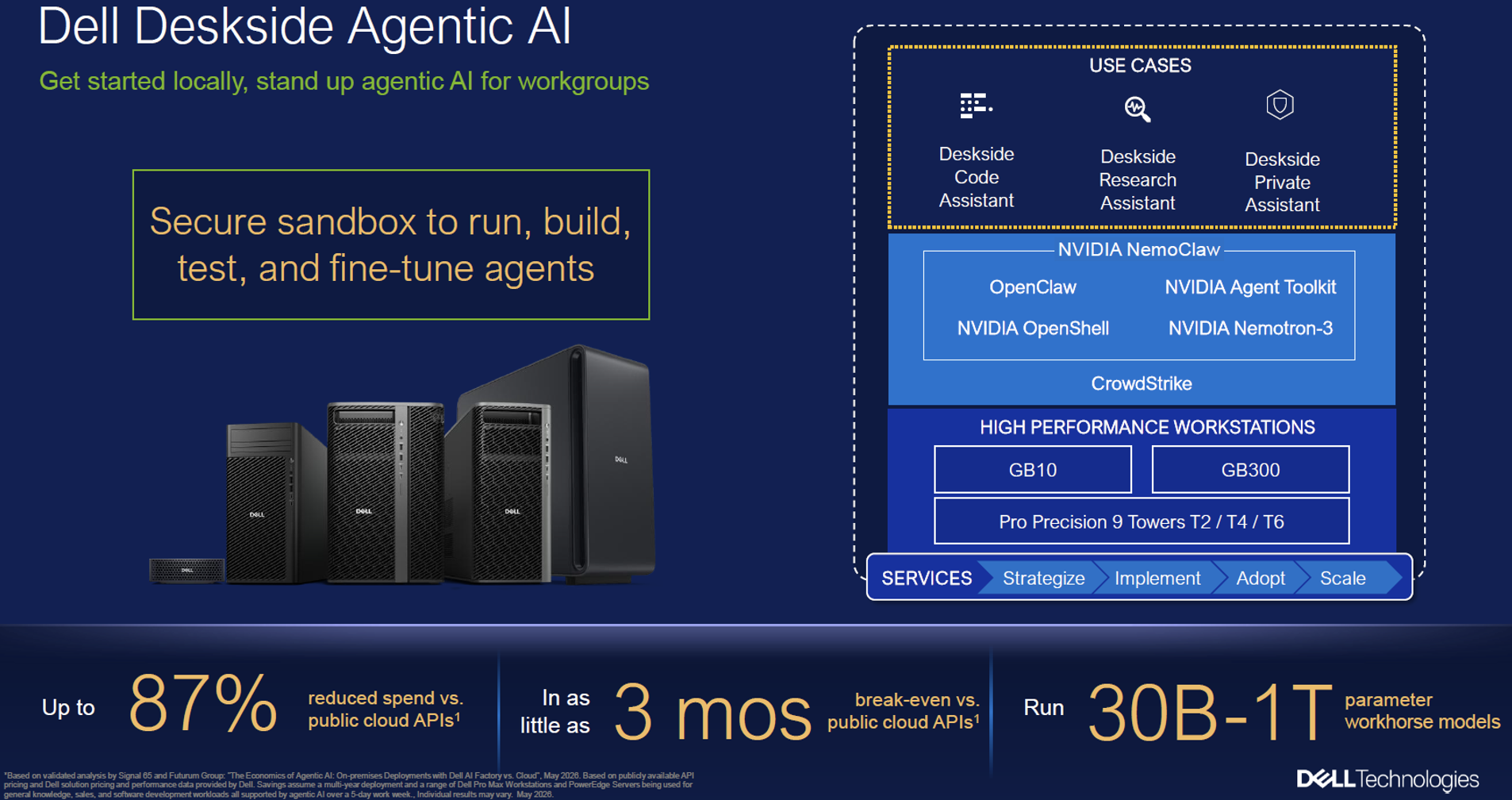
And this groundswell in retro infrastructure isn't just AI PCs. Did you see Dell Technologies' blowout quarter? Yes, there was a boom in AI infrastructure demand (and possibly some of it was pulled forward), but traditional servers surged. HPE followed up with a strong quarter in networking and traditional servers.


Cisco talked about how the network is the cornerstone of AI (sounds familiar for you old heads, eh?) at Cisco Live. Sure, Cisco CEO Chuck Robbins had a lot of agentic AI throughout his keynote, but this was more about systems (classic and newfangled AI factories) all aligning behind AI.

AMD CFO Jean Hu said at the Bank of America 2026 Global Technology Conference that the 1990s vibe isn't unexpected. AMD predicted that CPUs would regain their standing two years ago, even as everyone was GPU-happy.


Hu said:


"You can see continued momentum from training to inference, from AI adoption, experimentation, to more adoption at scale. Agentic AI is not about answering questions anymore. It's about orchestration, database access, and a lot of tool execution. And all of those require significant CPU performance. And what we are seeing is very significant and incremental demand for our CPU platforms.


We also are seeing the economics of AI keep changing. With the token generation going up so quickly, all the customers are really focusing on performance, TCO, and they're really trying to figure out how to use different computes to address different applications and workloads."

Dell Technologies' Arthur Lewis, President of the Infrastructure Solutions Group, said the new model is cloud- and edge-focused. It's not either or.


Smith said at an investor conference: "We wrote down a couple of different hypotheses when we first started down this path of artificial intelligence in the beginning of '22. And one of them was that there's going to be strong gravity to data. And that's proven out to be the case. 83% of data sits on-prem today in the world across a majority of enterprises, and there's a strong proclivity to deploy on-prem for performance, cost, and security reasons."


That bet has paid off as Dell is selling servers of all types at a rapid clip as well as PCs. It's all a bit client-server.


Trillions of dollars on FOMO


When I look at the AI infrastructure market, I can't help but think this seems like real estate in 2006 and 2021. Both times, there was a rush on assets. In the first real estate bubble, there was FOMO about buying homes because they could only go up. Then came the mortgage-driven crash in 2008.

During the COVID pandemic, there was a rush to buy homes in places with lots of sun. Austin and Florida boomed based on the premise we'd all never go back to the office. Ask those folks who bought in 2022 how it worked out.


Since we're talking hard assets, AI data centers rhyme a bit. There's no moderation in spending because we all assume OpenAI and Anthropic will grow forever and can pay their trillion-dollar tabs. It's FOMO-ish.


Alphabet completed an $85 billion equity offering to fund its AI infrastructure investments. There's not a quarter where the AI infrastructure tab doesn't go up. Goldman Sachs expects a combined $7.6 trillion in capex on compute, data centers, and power between 2026 and 2031.


The economics of artificial intelligence are more questionable today than two years ago, said Goldman Sachs Research's Jim Covello, Head of Research, in a podcast.


Covello said:


"There's a tremendous amount of FOMO at every level of the supply chain. And it doesn't mean it's unjustified. I just think that we're spending well in advance of where the economics are right now. And I think it's because everybody is afraid of what happens if the technology really takes off and finds significant positive economic use cases. And your competitors have that figured out, and you don't. And I think that's everything from the enterprise level to the model layer to the hyperscaler layer."


The big question


All this 1990s nostalgia spurs a very expensive question: What if our AI infrastructure is already built?

If AI inference is what makes the agentic world go around, we're really talking about a massive upgrade cycle for CPUs rather than massive AI factories with a massive gap between announcement, depreciation, and actually turning on the lights. Sure, there's the cloud, and there will be demand to ultimately justify the investment, but there's so much compute that's not being harnessed.


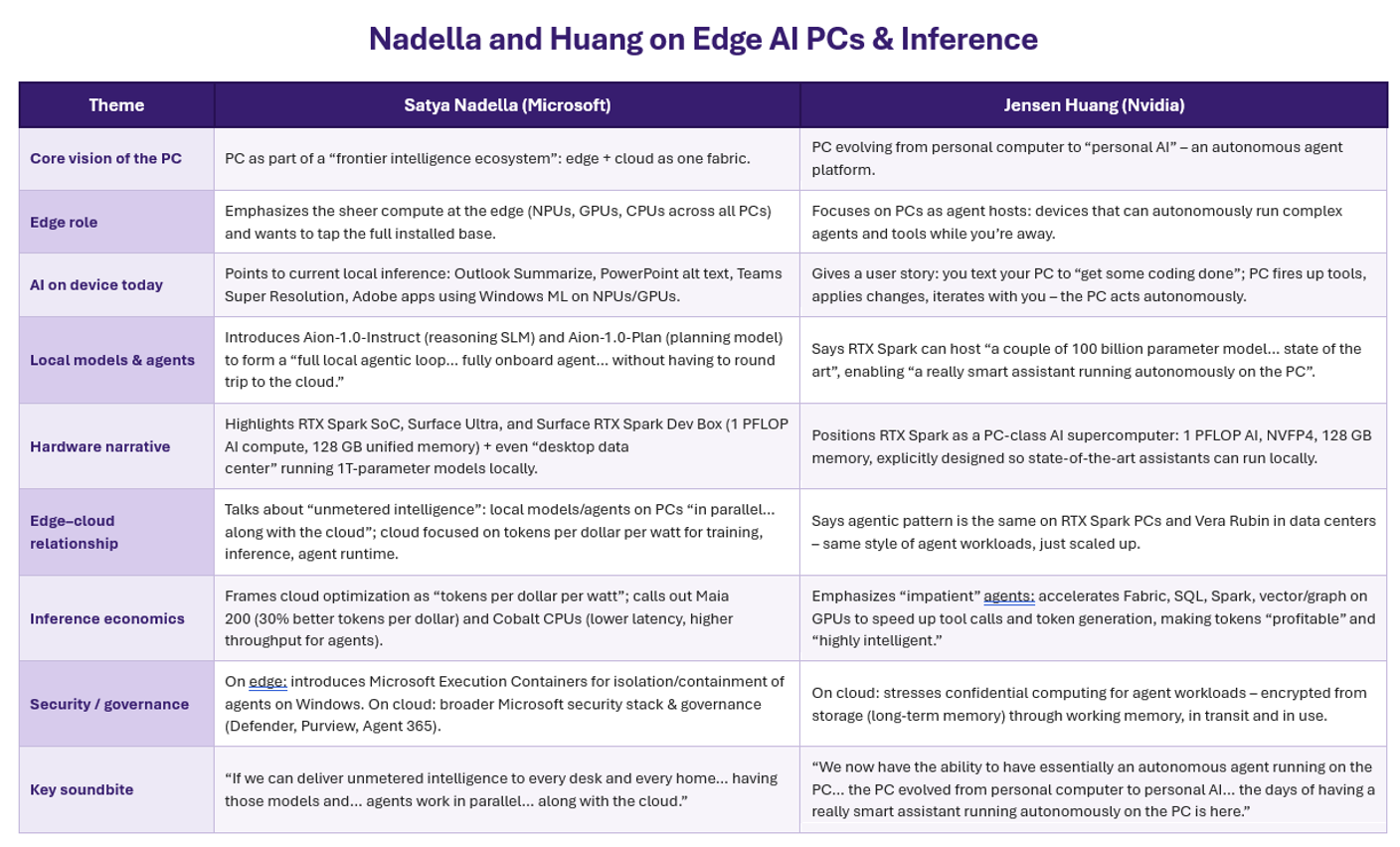
Nadella said: "Let's start at the edge with Windows, because when you step back, the amount of compute there is at the edge is actually astounding. Think about every NPU, GPU, CPU, even every PC. If you sort of aggregate that, that's a lot of compute power. If we can deliver unmetered intelligence to every desk and every home, it takes us all the way back to the very beginning."

Is the goal to spend a gazillion on capex on building AI factories or delivering Nadella's "token per dollar per watt?" If it's the latter, we may need to think more about the edge. There will be handoffs to the cloud for sure, but there's no sense in building the next mainframe in the Midwest when a potentially more elegant architecture is already in place.

Nadella repeatedly mentioned unmetered intelligence to describe his vision of edge AI working in concert with the cloud. "This idea of unmetered intelligence is about having those models and having the agents using the models work in parallel (at the edge) to what you may be doing along with the cloud as well," he said.


In other words, it's the orchestration, stupid. Perhaps we need another Napster to aggregate and optimize compute, with a fancy LLM provider actually paying you for spare compute.


Now, if we play this theory out a bit farther, just think about all of those edge data centers run by telecoms. Do those assets play an AI inference role? Of course, they do.


The more you go down this AI rabbit hole, the more the 1990s theme seems to make sense. That's why Huang is suddenly Captain CPU.


Constellation Research analyst Esteban Kolsky said it's likely the AI value will be some combination of server and edge. The 1990s model didn't quite work because we didn't have the "glue" between systems that grew up in silos across compute, data, storage, and networking. "It's more than power. It's how you concentrate it and how you leverage it. You need an orchestrator," said Kolsky.


"The 1995 vibe is true, but many cycles forward. The opportunity remains the same, but the market dynamics have changed. You have to imagine the opportunities and possibilities," said Kolsky.


NOTEBOOK


📒 For more on Workday developer strategy and the latest news, see Constellation Insights and Notebook.


🔒 It has been a week of cybersecurity earnings, and CrowdStrike and Palo Alto Networks said Anthropic’s Mythos has boosted demand. See: CrowdStrike delivers strong Q1, ups outlook | Palo Alto Networks Q3 strong as CEO says Mythos boosted demand | Zscaler Q3 strong, outlook hit by component costs, sales turnover. In addition, Anthropic said it expanded its Mythos Preview-powered Project Glasswing.


📈 Broadcom delivered a strong second quarter and said revenue growth will accelerate to 84% in the third quarter.


💰 HPE posted a blowout quarter with revenue growth of 40% in its fiscal second quarter as the AI infrastructure boom continues.


🎯 Intel is taking aim at more efficient AI inference. At Computex, Intel outlined the following: Intel Xeon 6+ processors with efficient cores, an expansion of its 800 Series Ethernet lineup, and a tease of its Crescent Island GPU.


❄️ Snowflake is doubling down on data interoperability via Iceberg, creating a context layer for its Horizon Catalog, adding data streaming to Snowflake CoCo (formerly Cortex Code), and enabling custom model training via Snowflake CoWork (formerly Snowflake Intelligence) to reach business users and teams.


🧑‍💻 OpenAI said Codex has more than 5 million weekly active users, with knowledge workers representing 20% of users and growing rapidly.


🔔 Anthropic and OpenAI are competing to become publicly traded companies. Anthropic said it has confidentially filed to go public with the US Securities and Exchange Commission.


🫱🏽‍🫲🏾 Salesforce said it will acquire Contentful, a well-known headless content management system provider. See Liz Miller’s take.


💡 Esteban Kolsky started a series on the CEO’s AI dashboard.


✅ According to a survey from UserTesting, there's widespread anxiety and frustration with software updates.


🫱🏽‍🫲🏾 UKG named Rod Johnson, a former Oracle executive, Chief Revenue Officer. Johnson will report to CEO Jennifer Morgan. Johnson previously served as EVP of North America Applications at Oracle.


🧠 Knowledge at Wharton has a good post on whether AI is killing UX. The post is worth a read given that UX is allegedly disappearing and being replaced with an all-encompassing chat interface.


💻 D-Wave Quantum is spreading its bets on quantum computing systems. The company is best known for its annealing systems, but is now launching a roadmap for gate-model systems.


Insights Archive

Like getting our weekly round-up? Subscribe to Constellation Insights for consistent news and analysis on technology trends, earnings, enterprise updates and more.

Want to work with Constellation analysts? Our Sales team would love to get in touch!

You are receiving this email as you signed up for our newsletters.

Want to change how you receive these emails?

You can Unsubscribe or Update your preferences