| | | | | |
There is an AI pricing revolt underway, and it’s unclear whether vendors will be able to ease the pain at the expense of short-term results. These issues will be front and center for the remainder of 2026, and the answers will be found in better metrics, greater visibility, and pricing models that make sense for customers.
Palantir CEO Alex Karp typically has a lot to say, but he's not wrong about the LLM revolt, even if he is just talking his game. Karp has a full campaign going against frontier model companies and their token-happy models. Karp argued that enterprises need a way to control their own destiny, which means using their own models tailored to their business. | | | | "People understand that they need a way of controlling their alpha. They broadly understand that tokenmaxxing comes at their own cost, and they certainly understand that it is leading them to transfer their data, their prompts, the way they run their business, and their expertise to a third party. They need education on what they can do about that with us, preferably, but also without us," said Karp.
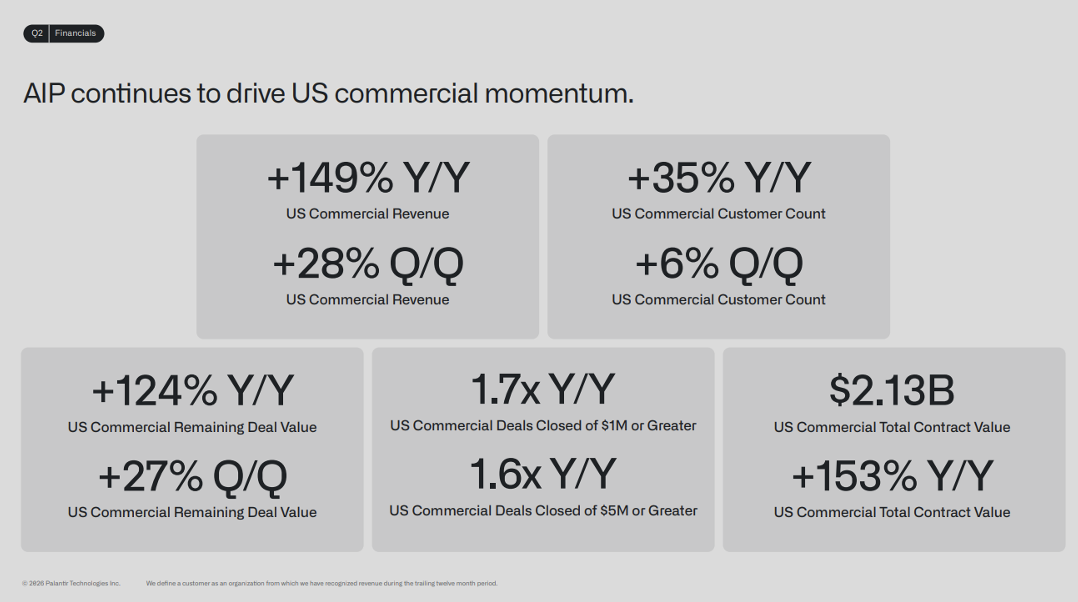
Indeed, Karp said Palantir's second quarter earnings show how the company is benefiting from the LLM revolt.
Blustery? Yep. Wrong? Nope.
Uber, one of the poster companies of blowing through AI budgets, noted that it has its token budget under control.
Call it the quiet tokenmaxxing revolt. Uber CFO Balaji Krishnamurthy said: "On AI, we are optimizing token spend by setting better defaults for different use cases, moving certain tasks to lower-cost or open-weight models, and letting employees more clearly understand and manage their spend. As a result, cost per token has declined over the past several months, even as adoption has continued to increase, allowing us to keep overall AI spend broadly stable."
And in a sign of how enterprises need to better measure AI value, The Linux Foundation launched the Tokenomics Foundation. Aside from a horrible name and the fact that maybe some executives should have been thinking about ROI in the first place, the group will define metrics to measure AI value and total cost of ownership. The effort aims to examine the entire supply chain, including the energy and capital used to create tokens, AI servers, and consumption, as well as outcomes. Adjacent costs for AI include compute, storage, databases, engineers, and tokens. | | | | This mild token-meets-overthinking-LLM revolt has even reached Anthropic. The company released a guide to help IT admins control Claude Enterprise costs. Anthropic helpfully notes in a blog:
"It’s helpful to measure AI’s cost-per-outcome instead of token consumption as the primary metric of value. Here are two questions to ask about a project: - What would this work have cost without AI, whether in resources, time, or never attempting the project at all?
- Is a model completing a task that is hard and requires judgment and reasoning, or is it just large, meaning a high volume of straightforward work? “
Not surprisingly, Anthropic didn't exactly tell you to use your own tailored open-weight models and focused on its portfolio of offerings. It also didn’t tell you that its model depends on you being an idiot about your token spending.
Simply put, questions about the value of AI are being asked everywhere. Finding the answers will require a few things to fall into place. Here's a look at the big three items needed for grown-up AI:
Metrics. The Linux Foundation is addressing the AI value issue because today's metrics have been defined by enterprise vendors who are making value barometers up on the fly. Constellation Research's Esteban Kolsky recently noted in his CEO AI Dashboard Series:
"The first problem is that most AI economics are still being discussed in the vendor’s language. Token prices, usage-based pricing, and outcome-based pricing all matter, but they are still supply-side metrics. They describe how the providers want to charge for intelligence. They do not answer how the enterprise should think about value. As the novelty phase of AI is fading, boards and CEOs are left with a familiar problem: significant spending, unclear payback timing, and little agreement on what should count as return."
Transparency. Enterprises want the transparency into budgets that cloud hyperscalers provide. Most vendors rolling out agentic AI aren't accustomed to providing transparency due to seat-based pricing. For instance, enterprise software vendors are just catching up to the observability dashboards needed to manage the AI budget.
CxOs will need tools to show what they're using, where, and by whom, as well as the business value they provide. From there, enterprises need to budget, optimize, and avoid overspending. Should enterprise vendors fail to provide this transparency, procurement departments will move to hyperscalers, notably AWS Marketplace.
Vendor pricing models. Enterprise vendor pricing models are in flux and keeping up is exhausting. Consumption, credits, and licensing models are being combined into hybrid approaches. Since these models change almost quarterly, customers are confused and fatigued. Toss in your friendly neighborhood forward-deployed engineer (real or sales-ish) and budget surprises abound. Vendor pricing model shifts are likely to be at the expense of short-term gains. HubSpot cited a shift to outcome-based pricing and longer sales cycles due to the tokenmaxxing hangover for its disappointing third quarter outlook. Three quotes from HubSpot CEO Yamini Rangan tell the tale: - “On pricing, predictability has become a defining theme in AI adoption. Businesses have been hit with unpredictable token costs. And they want pricing that is transparent and tied to value.”
- “Purchase decisions are facing greater scrutiny, buying committees are larger, and more deals require C-suite and Board approval, leading to longer sales cycles.”
- “We introduced outcome-based pricing so that we could tie the agent value to the value that they're getting, and we gave customers much better visibility and spend control. They can set thresholds for what they want to spend. Now these decisions create a near-term headwind, and the decision we made is we'd rather remove friction and build customer confidence at the beginning of the AI journey and then help them drive much more adoption as they continue.”
Constellation Research has monitored these pricing model changes, and you can expect more. Vendors are throwing a little bit of everything at the wall. Outcomes, consumption, and upfront credit purchases are becoming the norm. Some of these pricing schemes will resonate with customers and others will bomb spectacularly. The only certainty is that tokens won't be in the mix. The anti-token sentiment is brewing big time.
Observations - Am I the only one who starts humming Billy Joel's You May Be Right when listening to Elon Musk? During SpaceX's earnings call, its first since going public, Musk was dropping some choice quotes that suggest he either can predict the future or is wildly promoting his company and projects. According to Musk, SpaceX's Starlink will put telecom carriers out of business. Data centers will become much more efficient because designing them is way easier than rockets. And $1 trillion in revenue by 2030? No problem. He may be right. He may be crazy. And it's totally unclear whether Musk is the lunatic investors are looking for. One thing is certain: The lockup period for SpaceX is ending, and shares will be under selling pressure through the World Series.
- Given the AI flux, your main mission is to create an architecture that can give you the most options. Architecture matters, and few are focusing on it. Altimetrik CEO Raj Sundaresan said enterprises have fallen into AI optimization traps that aren't working because architecture has been put on the back burner. "Everyone wants to jump into solutions and impress the board, but they're missing this big thing around architecture. If you want to bring everything together for production scale you have to make it fit within your existing architecture. You need a well-defined architecture to bring AI into the mix," he said. For more, see how Verizon’s architecture manages agents and how Virgin Australia created a vendor-agnostic stack.
- Anthropic and OpenAI models are your hacking nightmare...or not. Another week, another hack by frontier models simply looking to do well on cybersecurity benchmarks. Is it worrisome or just marketing? Your guess is as good as mine. For now, keep abreast of the headlines because your board is going to start asking about defending against AI agents any minute now. One nagging thought: Humans trained the models, and some humans are really good at bending rules and/or being good criminals.
- Here at Constellation Research, we sometimes have some really nerdy debates. The latest water cooler debate was over RAG. Mike Ni said that you shouldn't underestimate it. Esteban Kolsky called it antiquated. All I could think about is a headline: Stop ragging on RAG!
| | | | | | | | 🫱🏽🫲🏾 Salesforce said in an SEC filing that Srini Tallapragada has decided to step down from his role as President and Chief Engineering and Customer Success Officer. He will serve as an advisor for a year to assist with the transition of his duties. The move comes as Salesforce appointed Miquel Milano chief operating officer, according to CNBC. Rohan Kumar will become chief platform and engineering officer. Alexa Vignone will be chief revenue officer.
🧠 Should we be worried about Google’s AI brain drain? Demis Hassabis will step down as Google DeepMind CEO to become its chair and add the title of Alphabet chief scientist. The move comes amid a shakeup at Google DeepMind where four top execs are leaving to form Discovery Loop, an AI startup focused on key industry breakthroughs. In a note to staff, Hassabis said: "We have arrived at a pivotal moment in human history. I’ve been working towards AGI my whole life, and now, like many of you, I feel it is close at hand. It’s critical that we collectively get the next steps right to ensure this all goes well for humanity and we usher in an incredible new age of discovery and wonder."
🛎️ Here’s a parade of earnings decks from Pinterest, Shopify, Caterpillar, Match, Western Digital, Dynatrace, IonQ, Sandisk and Kyndryl.
🚀 Meta released Muse Code in beta. Muse Code is a coding agent powered by Muse Spark 1.2. The company also offered a lower-priced "contributor" tier for Muse Spark 1.2.
Mistral launches Shieldstral, a 3B open-weights multimodal safety classifier model designed for moderation and policy-adaptive Q&A. The model is released under the Apache 2.0 license.
🥄 Bending Spoons, a technology rollup that owns AOL, Brightcove, Eventbright, Vimeo and others, said it has acquired Airtable in a deal valued at $1.285 billion. Bending Spoons recently went public at $29 a share. Shares are currently at about $36.
❌ Texas Governor Greg Abbott has ordered a moratorium on the approval of data center projects until the Public Utility Commission of Texas and the Electric Reliability Council of Texas can perform audits on proposed data centers trying to connect to the state's electric grid.
💬 OpenAI has responded to Apple’s lawsuit over IP theft and posted messages exchanged between employees of the two companies (heavily redacted so they are essentially useless).
📈 TopTal's quarterly report on technology, design, finance and services hiring is showing an uptick. In the company's second quarter report, TopTal reported the following: Market strength scores were strongest for data science experts, up 14% from a year ago; finance consultants, up 42%; product managers, up 27%, and project managers, up 14%.
🫱🏽🫲🏾 Visa said it will acquire BioCatch, which provides behavioral-first multi-signal fraud detection systems. BioCatch uses AI and machine learning to analyze keystrokes, touch gestures and device handling to help detect fraud.
💲Persistent Systems said first quarter revenue was up 16% from a year ago to $452.4 million. The company said it had record quarterly total contract value of $1.15 billion. | | | |
Insights Archive Enterprise AI grows up, vendors are noticing How UnitedHealth Group sets its AI stack, targets 1,000 use cases Enterprise vendor pecking order will be upended by volatility, AI inflection points Here’s what we learned about AI projects from enterprise buyers so far Here’s what we learned about AI projects from enterprise buyers so far Don't let your vendor's AI strategy become yours For Starbucks, AI returns are behind the scenes What if our AI infrastructure is already built? How to avoid vendor lock-in in the AI age AI inference costs will be a major concern: What's the fix? How Prudential CTO Liz Brand is approaching agentic AI, transformation The private preview plague Google Cloud, AWS, Microsoft Azure: The AI vertical integration race How Verizon manages AI agent sprawl The space race and what it means for enterprises Google Cloud Next 2026: A look at the big themes Your AI talent planning algorithm is common sense Zillow bets on content, context, data flywheel as AI differentiator AI Forum 2026: There isn’t an easy button for AI Constellation Research's Futures Forum: What CEOs are thinking Where’s tokenomics for the rest of us?
Disruption coming for ERP and not from where you'd think
Anthropic vs. SaaS: A nuanced view
Zoho Day 2026 themes to watch: ERP, SaaS, customer value, AI, sovereignty
How three hotel giants are playing agentic commerce, AI
SaaS under the microscope: How to evaluate your vendor Forward-deployed engineers: The promise, peril in AI deployments Caterpillar’s AI Vision Takes Shape, but Data, Cloud Focus Was the Precursor Agentic AI experiences will determine enterprise winners Why enterprise AI leaders need to bank on open-source LLMs -
Enterprise technology 2026: 15 AI, SaaS, data, business trends to watch
| | | | | | | | | | | |