| | | | | |
Aligning AI projects to business outcomes, model routing, governance, perpetually rewriting software, process, and managing humans were core topics at Constellation Research’s AI Forum in New York City, but the big theme is that best practices and projects are maturing.
The September edition of Constellation Research’s AI Forum 2026 is that AI projects have matured even since March. The growing pains are still there and enterprise AI needs better connective tissue between AI agents and business outcomes. But enterprise AI is headed in the right direction. Here are some takeaways from Constellation Research’s AI Forum in New York.
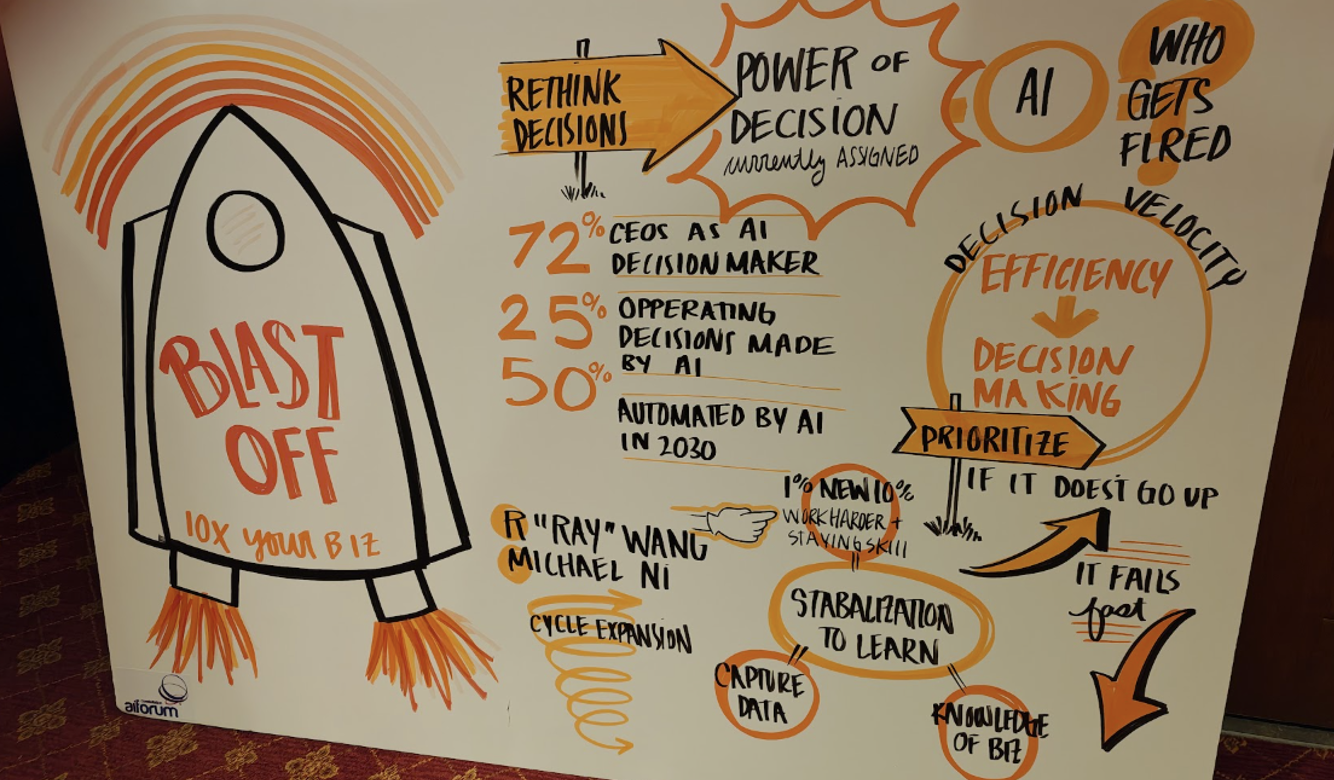
Enterprise AI will pivot to decision velocity and learning loops.
Yes, AI projects need to deliver returns, with AI agents automating business, but the emerging theme is changing your architecture so you can make decisions faster. The enterprise AI game will revolve around getting more at-bats for decisions and iterating. You want to be the company that gets 10 at-bats due to AI in the time a rival makes one decision.
Constellation Research analyst Mike Ni was quick to note that decision velocity and more at-bats only work if you learn from each one. "If I'm not making the 11th decision better because of what I learned in the first 10, then I'm actually losing,” said Ni. “Dashboards die, and we’re seeing learning loops as the place where enterprises actually live.”
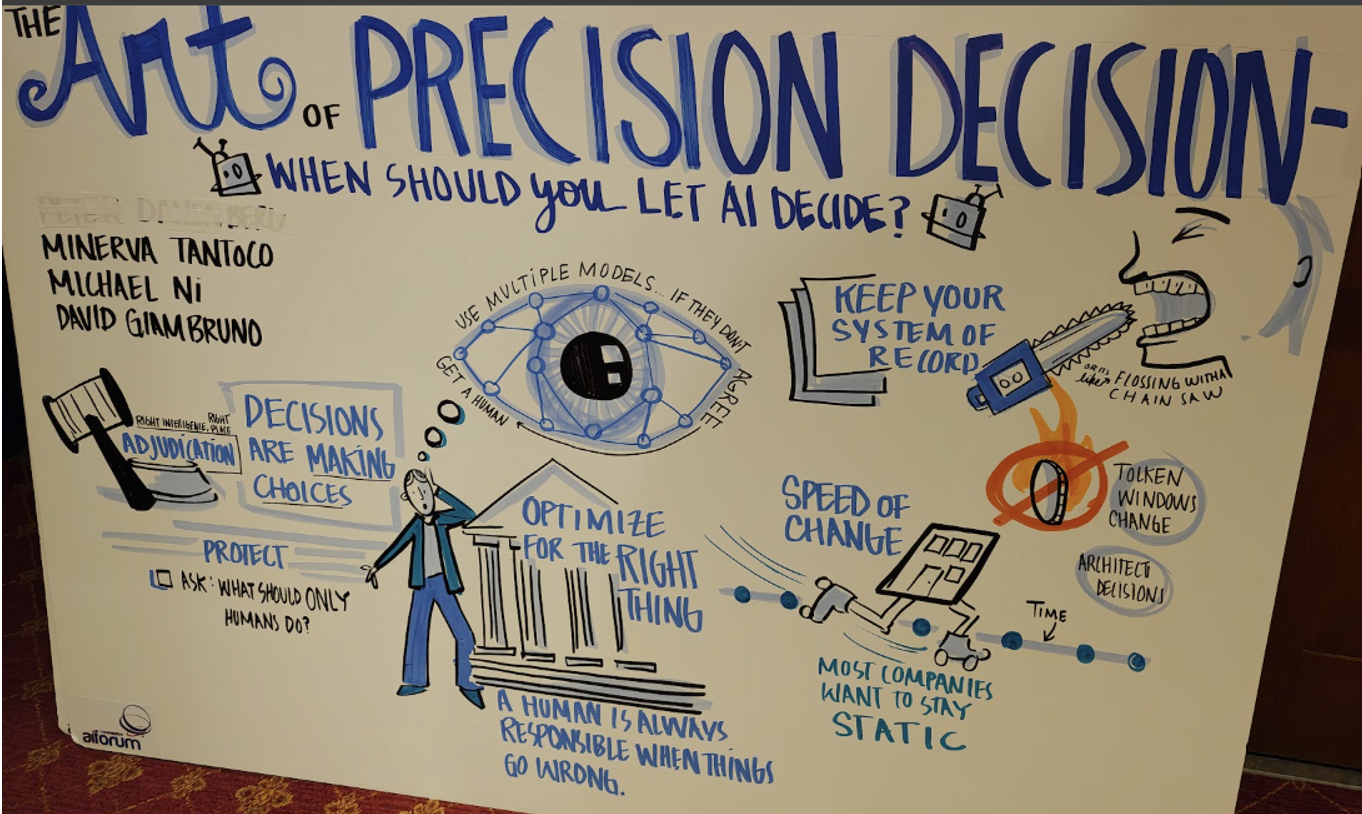
These learning loops will require enterprises to balance deterministic and probabilistic processes. “Automate the deterministic processes. Take the probabilistic processes and improve the precision,” said Constellation Research CEO R “Ray” Wang. | | | | AI cost is a massive problem and model routing may be an answer.
Chris Hallenbeck, SVP and GM of AI & Platform at Boomi, outlined how the company is cutting its Anthropic bill internally using the company's software. Hallenbeck said he optimizes costs with teams across Boomi using small language models and model routing.
He said: "We were all thinking we're going to have an agent sprawl problem. We don't. We have a skills sprawl problem right now. First of all, skills are growing massively. Our own company has over 6,000 in regular use. We're only a billion-dollar company, so put that in perspective. We only have about 250 agents running processes and agentic workflows to core agents.
Skills are where the cost and the token usage is hitting us, and where the big bill from one of the big frontier models is crushing us. Through model routing, engineers are still using they're still using Claude Code, but we intercept that and then model route it based on the size of their wallet and activity. We're beginning to look at the individual request and route it automatically with our own software. And we've taken 15 times out of our Anthropic bill for our engineers."
Hallenbeck said his team is running business case analysis for work. Engineers building skills is one thing. Building slides is another. With model routing, Boomi has cut its costs for building skills by 87%. Employees are using the tool of their choice, but model routing in the background can save money. Don't rely on the user to pick the best model. Architect for multiple models and optionality between deterministic and probabilistic outcomes.
David Giambruno, Managing Partner at Ancilla, said deterministic models and processes give you the accuracy you need on the budget you want. Deterministic code is nearly free to write now and easier to audit. "Almost everything a corporation does is deterministic. There is very little that's not," said Giambruno. "The best token you can spend is the one you don't need. Why would you ask a frontier LLM how to calculate two plus two?" | | | | Process and talent debt are as critical as tech debt for AI success.
Vijay Vijayasankar, Global Agentic AI Officer at Genpact, said the IT debt issue is well known. What's overlooked is process debt and talent debt. "There's a lot of discussion on these topics. Many CIOs and CTOs have convinced their CEOs and CFOs to spend money on that. Now, this is a sin that has been committed for a long time, so it's not like in the next year, you know, people will overcome all that debt. But the part of the debt that does not get talked about very much is the process debt and the talent debt," said Vijayasankar. See: Genpact's AI chief Vijayasankar: Don't forget process, talent debt in AI projects
Industry use cases for AI picking up
Hiral Chandrana, CEO of Veltris, said vertical AI projects are likely to have the most potential because the combination of curated data, industry-specific workflows with guardrails, and automation will drive business outcomes. Chandrana said industry-specific AI use cases "will have the most P&L impact and cycle time impact." "That's where the value creation really happens," said Chandrana. See: Veltris CEO Chandrana on vertical AI, industrial AI use cases
AI sovereignty is broader than owning the technology.
Vincenzo Aquaro, Chief of Digital Government Branch at the United Nations, said AI sovereignty goes beyond technology. But the best outcome is probably virtual sovereignty where a nation controls the rules and data. "We believe it is not about who really physically owns the systems, the data, the infrastructure, but the ownership, the rules, and all the governance framework belong to the countries," said Aquaro, who noted that data control matters a lot more than the model used.
Rewriting software is perpetual now.
Giambruno walked through his AI agent projects and retiring tech debt. His take is that AI harnesses will go away, teams will get smaller, and enterprise software will be perpetually rewritten. He has been able to cut token budgets by 90% in many cases. Focus on the AISDLC (AI software development life cycle) and what’s a deterministic vs. probabilistic process. Embrace AI thinking and cut the tech debt you’re building instantly. “We're thinking about changing the product harness, and the AI comes back and says, "I am the product harness. The funniest things ever to watch with my teams scream at the agents,” he said. “We've done 101 releases in 55 days of AI improving itself, and 97% of the code to improve itself was written by itself.”
Continually building software revamps how you think about updating software. Anything you built a year ago is so outdated that you’re better off starting from scratch.
AI and human work: Questions abound.
While deploying AI has matured—even though most panelists put AI agents in the second inning and emphasized it’s early—the human issues aren’t resolved. Where do you put humans in the AI process? What is the future of work? Are humans merely accountability punching bags as AI runs a company? Some quotes to ponder: - "At each friction point, we used to say, 'Is it better off done by AI or human or both, and in what conditions?'" said Samir Kumar, Corporate Vice President of Growth and Innovation, Enterprise AI at Fortive.
- "It's really important not to anthropomorphize the agent. It's their assistant. It's their intern," said Asha Aravindakshan, COO of GlobalGiving Foundation, Inc.
- "We have built the agent with a human in the loop at the beginning and at the end and in the middle. The results have our name on it, and we're liable for it," said Aravindakshan.
- "I call bullshit; people write their whole documents with AI. I'm like, I know you have a brain. Let's see it on paper. I will call them out. If I can open a document and tell AI wrote it, I don't want to read it. I want to hear it from you. I will call people out publicly because I cannot have them passing off AI work as their own. I worry a lot about the cognitive offloading that people are doing, especially the younger employees," said Aravindakshan.
- "Unit cost comes down. More work goes around, so demand increases and jobs don't get lost. Judgment suddenly becomes pretty scarce, and that needs humans," said Vijayasankar.
- "It's a human who actually sets the goals, sets the context, and owns up to the decisions. AI can accelerate things, but actually the human is in the lead,” said Ajoy Menon, Accenture's Senior Managing Director, Digital Core Lead.
- "A year ago we had a team of six to eight. Five months ago, it was teams of four to five. It's now teams of two, and that's getting to be too many. It's air traffic control for our AISDLC (AI software development life cycle), which runs 68 agents. My team's job is to manage the agents, get the plane off the ground, and land the plane. We can run 12 projects at once, and so more than two people, you start colliding,” said Giambruno.
And while we’re at it, here’s a look at previous AI Forums. Note the progression. | | | |
Observations
The hype over Meta’s Muse AI agent is deafening and probably misplaced. The company’s Muse AI agent is free, so it will naturally get usage, and it feels like a huge moment that rhymes with OpenClaw, which I’ve already forgotten about. OpenClaw was huge in March, and now Muse has picked up the baton and will soon be embedded into Meta’s Ray-Ban glasses and available through a small device. Investors clearly think Meta has solved its AI monetization issues. A few reasons you should cool your jets on Meta’s Muse AI agent. - OpenAI and Google will have a knockoff by the end of next week.
- Just because you download the Muse AI agent on Apple’s App Store doesn't mean you'll pay for it or even use it. Remember Threads?
- Trust matters. I don't trust Mark Zuckerberg as far as I could throw him, and nothing since the beginning of social media would give me a reason to.
| | | |
Industrial AI is moving forward courtesy of physical AI models. QAD | Redzone launched Manufacturing Intelligence, designed to work across manufacturing processes, workflows, and systems by bringing together its enterprise resource planning system, AI agents, and new features for frontline workers and global trade. The company also said it will integrate Nvidia's technologies into its platform. IFS will host its conference next month and will likely tout manufacturing AI use cases. These industrial AI efforts are driving returns, but haven’t captured the public imagination because the robots haven’t quite arrived yet.
Anthropic and OpenAI got the pricing memo: Tokenmaxxing isn’t sustainable, and customers will go cheaper whenever possible. LLMs are a commodity. Anthropic and OpenAI both announced their latest and greatest models, but no one cared about the benchmarks. These model releases were all about the lower prices. The game plan for these two LLM giants? Build a portfolio of models across multiple price points to keep you from going to Nvidia, Nemotron, and other models. This price war is just starting, and Meta and SpaceXAI are going to squeeze Anthropic and OpenAI’s margins (excluding training costs, of course). | | | | Notebook
🗒️ For the latest on Teradata’s harness as well as Constellation Research’s AI Forum, see Insights and Notebook.
🧠 UiPath is leaning into its process mining roots, arguing that agentic AI needs a manual based on process knowledge and context.
👾 Microsoft said it has opened its quantum research center in the University of Maryland's Discover District and said it will provide topological qubits built on its Majorana 2 quantum chip for independent testing and evaluation by the Defense Advanced Research Projects Agency (DARPA).
🤖 A BlackRock paper, The Machine-Native Economy, is worth a read.
🚀 Alibaba launched its Zhenwu V900, its most powerful AI chip with three times the performance of its predecessor. Alibaba CEO Eddie Wu touted the company’s full AI stack as well as Qwen ecosystem.
🔁 Chemical giant Dow is betting that process optimization and automation can streamline operations enough to offset economic and supply chain volatility with savings ramping into 2027.
🚀 Google launched Gemini 3.8 Flash TTS and Gemini 3.8 Flash-Lite TTS. The company said the models are the "most expressive audio generation models yet."
🐴 LittleHorse Enterprises released Saddle Command Center 1.3, an update that makes it easier to create, deploy and bring AI applications to the enterprise. New features include agent creation, task workers, a JavaScript SDK and serverless trial offering.
📢 Amazon said it is opening its seller tools to third-party agents starting with Anthropic's Claude and Amazon Quick.
🐉 Qualcomm unveiled Snapdragon 8 Elite Extreme Gen 6 and Snapdragon 8 Elite Gen 6 in a move aimed at mobile experiences and on-device agentic AI.
🫱🏽🫲🏾 Nutanix said it will acquire Ryax Technologies, a company focused on AI compute orchestration and management software.
🔒 Deloitte report noted that audit committees are increasingly focusing on AI governance. The Audit Committee Practices Report found that 54% of respondents are more focused on emerging risks over the past year. Not surprisingly, 75% of respondents see AI governance as a top 3 priority, up from 35% a year ago.
🚀 SpaceXAI launched Grok 4.7, the company's most capable model, checking its own work more carefully. | | | |
Insights Archive Nvidia’s Nemotron hit enterprise AI inflection point Salesforce still has pricing work to do Why you should arbitrage your AI models like your vendors do Quantum computing: Where we stand in 2026 SaaS: Apocalypse over, sorting winners and losers just starting Why AI infrastructure folks are talking so much about applications AI value metrics and vendors need better pricing models Enterprise AI grows up, vendors are noticing How UnitedHealth Group sets its AI stack, targets 1,000 use cases Enterprise vendor pecking order will be upended by volatility, AI inflection points Here’s what we learned about AI projects from enterprise buyers so far Here’s what we learned about AI projects from enterprise buyers so far Don't let your vendor's AI strategy become yours For Starbucks, AI returns are behind the scenes What if our AI infrastructure is already built? How to avoid vendor lock-in in the AI age AI inference costs will be a major concern: What's the fix? How Prudential CTO Liz Brand is approaching agentic AI, transformation The private preview plague Google Cloud, AWS, Microsoft Azure: The AI vertical integration race How Verizon manages AI agent sprawl The space race and what it means for enterprises Google Cloud Next 2026: A look at the big themes Your AI talent planning algorithm is common sense Zillow bets on content, context, data flywheel as AI differentiator AI Forum 2026: There isn’t an easy button for AI Constellation Research's Futures Forum: What CEOs are thinking Where’s tokenomics for the rest of us?
Disruption coming for ERP and not from where you'd think
Anthropic vs. SaaS: A nuanced view
Zoho Day 2026 themes to watch: ERP, SaaS, customer value, AI, sovereignty
How three hotel giants are playing agentic commerce, AI
SaaS under the microscope: How to evaluate your vendor Forward-deployed engineers: The promise, peril in AI deployments Caterpillar’s AI Vision Takes Shape, but Data, Cloud Focus Was the Precursor Agentic AI experiences will determine enterprise winners Why enterprise AI leaders need to bank on open-source LLMs -
Enterprise technology 2026: 15 AI, SaaS, data, business trends to watch
| | | | | | | | | | | |