| | | | | |
The SaaS apocalypse appears to be over, but the process of sorting out winners from losers is just starting.
In February, March, and April, enterprise software stocks took turns being put in the woodshed. The common storyline was that Anthropic was going to kill the SaaS industry. The reality was much more nuanced.
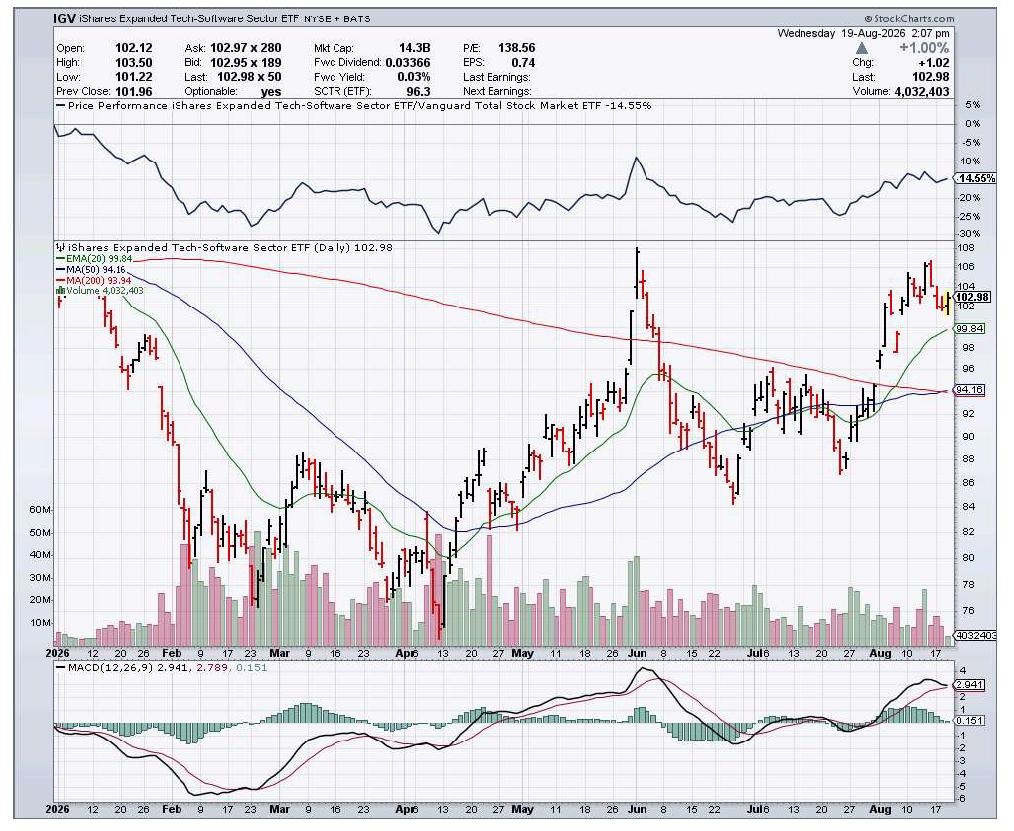
A refresher timeline: Keep that reality in mind as a batch of SaaS vendors, led by Salesforce, report earnings in the next two weeks or so. The iShares Expanded Tech-Software Sector ETF (IGV) shows the round-trip for SaaS stocks. Welcome back to flat on the year. | | | | Within that ETF, the volatility was extreme. Microsoft, Palantir, and Oracle, to name a few, crashed and bounced. Simply put, IGV churned a lot and went nowhere.
The stock market doesn't necessarily reflect what enterprises are doing with their IT budget, but in many cases, they rhyme. After all, boards of directors are more likely to note big moves down in a SaaS stock and start asking questions. The recoveries Palantir, ServiceNow, and Microsoft shares happened to coincide with revenue growth, presumably from enterprise buyers. Another big event also saved SaaS: Token and AI budget shocks. Once enterprises blew through AI budgets without much return, the relative predictability of SaaS vendor spending looked a bit better.
Anthropic and OpenAI weren't going to replace SaaS vendors as much as simply mark up their own offerings once they took share. Open-weight models have become so popular for a reason: they deliver better performance and returns for enterprises in many use cases. Open-weight models come with costs, but customization can drive returns.
Now what? The SaaS recession is over, but Wall Street is still repricing the sector. The recovery will be selective, and the SaaS vendors that can navigate usage-based demand, deliver outcomes, preserve their proprietary data, and deliver mission-critical value will do well. Another item to watch is how many enterprises choose to consume AI and LLMs through their SaaS vendor. Salesforce, Microsoft, SAP, Zoho, and others have said they are using their own models.
Your job will be to make sure you're not stuck with a future zombie vendor. You'll also want to avoid naming a vendor strategic just because the migration is painful.
SaaS volatility aside, here are some things to consider as you navigate the field. - Business differentiation. Does the SaaS vendor provide distinctive experiences, operating models, speed, or proprietary workflows? If not, you may have a replace-or-build signal. Palantir has thrived because it provides business differentiation.
- Mission-critical workloads. Systems of record often fall into this category, especially in regulated industries. SAP, Workday, Microsoft, Oracle, and Salesforce may fall into this category.
- Data and intelligence. Does the enterprise software vendor serve as your data engine? Databricks, along with Snowflake, may be the most disruptive enterprise software players as they enter new categories.
- Innovation cadence. Does the SaaS vendor's roadmap add new capabilities that drive returns quickly?
- Time-to-value. The SaaS vendor has to deliver time-to-value. The metrics for the foreseeable future are likely to be wonky — especially if vendors start pricing for outcomes.
- Risk absorption. One perk of SaaS is that risk shifts to the vendor. Security, compliance, and availability, as well as increasingly AI cost management, fall on the vendor.
Not all SaaS companies will do well enough for Wall Street, even if they have solid cash flow-generating businesses. There are certainly vendors in your portfolio where the capability doesn't differentiate, reinvent processes, and deliver a must-have platform. If you're only getting returns from 20% of what a vendor provides, you may want to build.
Vendors in the winner’s circle A word about the midmarket
The vendors mentioned above focus on large enterprises. The midmarket SaaS market will be different. Why? Midmarket companies are likely to use these vendors to consume AI because they lack the resources to build their own applications. Here are three to note: - You'd never know it from HubSpot's most recent earnings, but pricing by outcome makes sense in the long run. Midmarket enterprises will face challenges buying software on a consumption model.
- Freshworks is another midmarket player to watch. The company's AI is being consumed, and many companies on the midmarket-to-large-enterprise border want more value from the big guns with more complicated implementations.
- And if you move downstream, Intuit customers will consume a lot of AI through the company's various offerings, notably QuickBooks Online Advanced and Intuit Enterprise.
The birth of Data Inc.?
Google's $10 million acquisition of Spirit Airlines datahighlights the value of proprietary data to train models, bolster customer profiles, and improve prediction.
The big question is whether Google's purchase is merely opportunistic or the beginning of a more enterprise- and industry-specific data market.
Here's how the market for these proprietary data sets may play out. - Enterprises won't sell their data because it's their competitive advantage...or so they think. The common thinking is that every enterprise will leverage its own data to train open models for agentic AI. Data is the business moat, but it's highly likely some enterprises won't have the talent, skills, or business acumen to leverage their own datasets. For now, companies are trying to follow the Data Inc. approach, which was outlined in 2023 by Constellation Research CEO R "Ray" Wang.
- Some subset of enterprises will license proprietary data to monetize it beyond the company's business. Licensing your internal data is no different than a media company with its own streaming service, licensing to Netflix to monetize. Like media, some of those deals are incredibly short-sighted but pay the bills today.
- SaaS vendors that can anonymize data by industry could license it to model builders beyond what they do internally. Think industry-focused software providers with datasets to train models. Rootstock, Veeva, and Guidewire would be examples.
- Industries could create data-sharing arrangements to build focused models that can then be customized.
- And companies with insights into how work gets done could also set up data businesses. Celonis, ServiceNow, Workday, and SAP come to mind.
These data markets will develop. The timing remains to be seen. | | | |
NOTEBOOK
📒 For the latest Insights and breaking news, see Constellation Insights and Notebook.
🫱🏽🫲🏾 Marvell said Google has the right to buy nearly 59 million shares of the chipmaker at $206.58 a share. In an SEC filing, Marvell said the warrants are related to an expanded partnership between the two companies.
⏸️ OpenAI said it is pausing some reinforcement learning training for its frontier models to meet alignment, security, and monitoring standards.
❄️ Snowflake said it is adding dynamic model routing to its Cortex AI Gateway as it adds DeepSeek and Z.ai models to its ecosystem. The new features in Cortex AI Gateway are designed to improve AI economics, expand model choices, and give enterprises more granular AI usage and cost controls.
📉 OpenAI reportedly told investors that its second-quarter revenue grew 18% sequentially, with larger losses. According to The Wall Street Journal, OpenAI's second-quarter revenue was $6.7 billion, up from $5.7 billion. The second-quarter operating loss was $12.3 billion. Simply put, OpenAI's financials look bad compared to Anthropic's doubling of revenue to $11.6 billion in the second quarter.
🛍️ Retail earnings were on parade this week with Home Depot, Lowe’s, TJX, and Target reporting.
🏗️ OpenAI said it will lease an 8-gigawatt data center project in Ohio with SB Energy and Nvidia providing a backstop.
🏷️ The most valuable benchmark for large language models—open and proprietary—is quickly becoming price. Google launched Gemini 3.7 Flash, which is billed as its most intelligent workforce model, and included a promotional price that’ll run until January 1, 2027.
📈 Databricks said it passed the $7 billion annual revenue run rate in the second quarter. The company is now valued at $190 billion.
🫡 Klarna said CFO Niclas Neglén and CMO David Sandström will leave the company in early 2027. The company also cut its outlook for the third quarter due to weakness in Germany. Klarna's second-quarter results were solid.
🔒 Weave, a healthcare software provider, is going private in a $650 million deal. Under the terms of the deal, Francisco Partners will pay $7.40 a share for Weave. Weave was founded in 2008 and offers customer experience and payments software for medium-sized healthcare businesses. With Francisco Partners, Weave said it will expand its AI platform plans.
🤫 Anthropic's annual revenue run rate is $65 billion as of the end of July. The company is talking to investors, but its IPO filing remains confidential. Bloomberg originally reported the news. Anthropic's second-quarter revenue was about $11.5 billion.
| | | |
Insights Archive Why AI infrastructure folks are talking so much about applications AI value metrics and vendors need better pricing models Enterprise AI grows up, vendors are noticing How UnitedHealth Group sets its AI stack, targets 1,000 use cases Enterprise vendor pecking order will be upended by volatility, AI inflection points Here’s what we learned about AI projects from enterprise buyers so far Here’s what we learned about AI projects from enterprise buyers so far Don't let your vendor's AI strategy become yours For Starbucks, AI returns are behind the scenes What if our AI infrastructure is already built? How to avoid vendor lock-in in the AI age AI inference costs will be a major concern: What's the fix? How Prudential CTO Liz Brand is approaching agentic AI, transformation The private preview plague Google Cloud, AWS, Microsoft Azure: The AI vertical integration race How Verizon manages AI agent sprawl The space race and what it means for enterprises Google Cloud Next 2026: A look at the big themes Your AI talent planning algorithm is common sense Zillow bets on content, context, data flywheel as AI differentiator AI Forum 2026: There isn’t an easy button for AI Constellation Research's Futures Forum: What CEOs are thinking Where’s tokenomics for the rest of us?
Disruption coming for ERP and not from where you'd think
Anthropic vs. SaaS: A nuanced view
Zoho Day 2026 themes to watch: ERP, SaaS, customer value, AI, sovereignty
How three hotel giants are playing agentic commerce, AI
SaaS under the microscope: How to evaluate your vendor Forward-deployed engineers: The promise, peril in AI deployments Caterpillar’s AI Vision Takes Shape, but Data, Cloud Focus Was the Precursor Agentic AI experiences will determine enterprise winners Why enterprise AI leaders need to bank on open-source LLMs -
Enterprise technology 2026: 15 AI, SaaS, data, business trends to watch
| | | | | | | | | | | |