| | | | | |
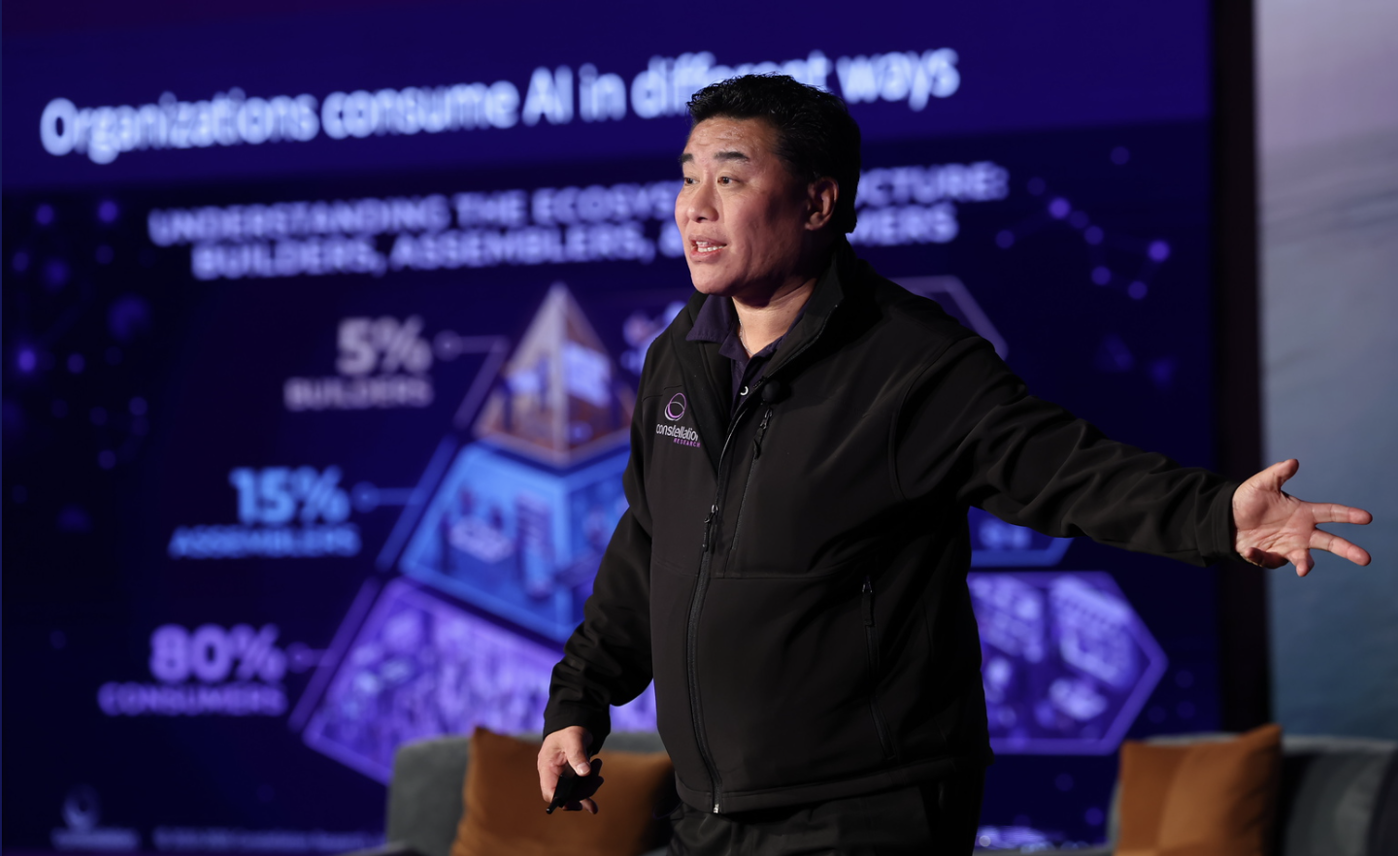
Enterprise leaders have moved from worrying they aren’t moving fast enough to a more mature approach: developing AI playbooks. Constellation Research CEO R “Ray” Wang outlined the AI playbook and the themes that matter.
The economic backdrop driving AI adoption is margin compression, exponential scale and outcomes are growing in importance, and companies will organize around them. | | | |
Here's a look at Wang's AI playbook and rules of the road, followed by the more nuanced themes at CCE 2026. - The goal is to make faster decisions. "Machines are making hundreds, 1000s of decisions per second. Your competitors are going to run circles around you," said Wang.
- Your business graph is your most valuable asset. The business graph is the record of your company's interactions and metadata. You need to keep it away from AI labs and competitors.
- Know where to put a human. "You do not look at automation. What you want to think about is when and where you insert a human in your decision tree," said Wang.
- Handing a customer to a human is a cost decision. "Your customer lifetime value better be high enough before I let you talk to a human, because I'm going to lose money in every interaction," said Wang.
- Processes are learning loops. "In every process, we're going to loop it over and over until we get to higher levels of precision," said Wang.
- Every AI decision needs a human owner. Wang said enterprises need to inventory AI use cases, create clear accountability for each one, audit trails, and escalation points. "Who's the decision maker for the outcome?" said Wang. "It can't be AI. There has to be a human on the back end."
Here's a look at the big themes from Constellation Research's Connected Enterprise 2026 that impact the AI playbook.
Managing at machine scale isn’t going to be easy
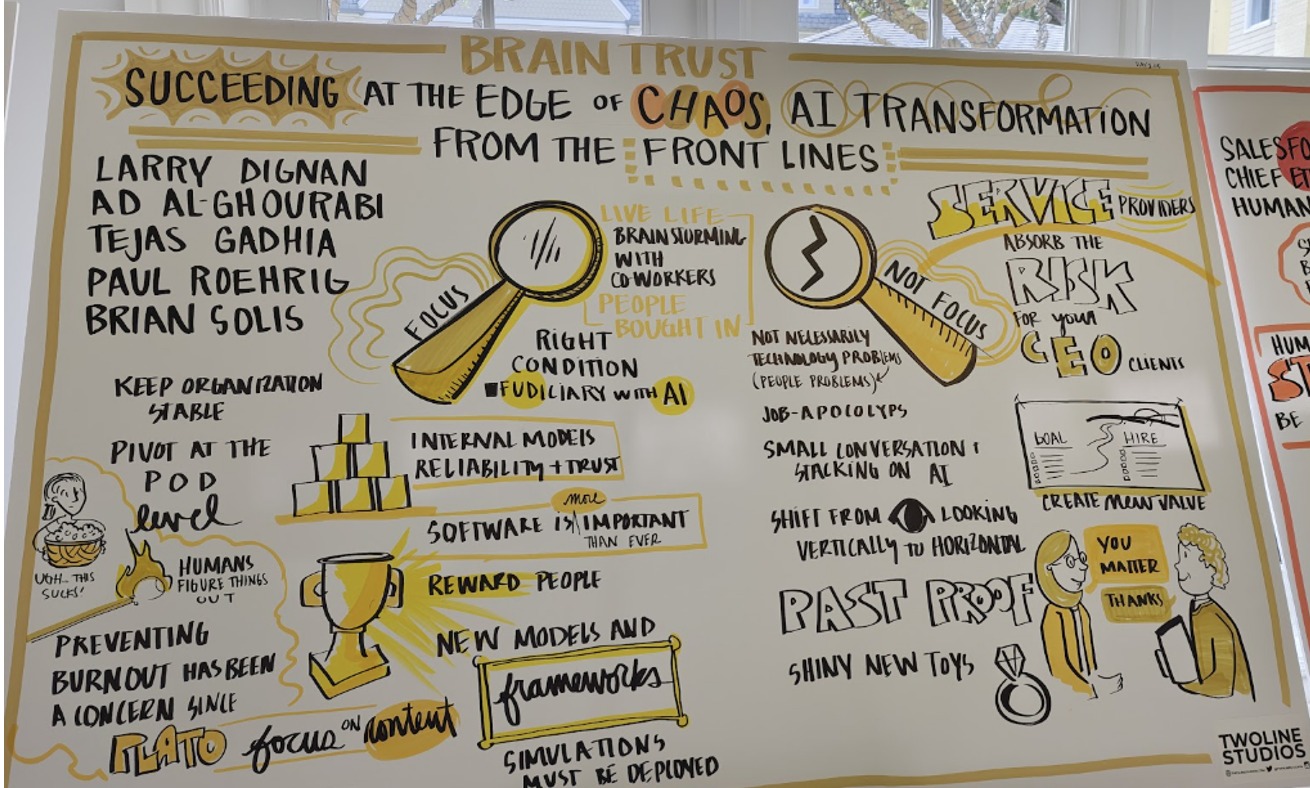
Managing at the intersection of human and digital workers is chaotic, and most enterprises are clearly winging it. CxOs are managing for the short term, but they also need to think about the long game. Immediate priorities include change management, people and processes, and burnout.
Operating at machine scale has put humans on a hamster wheel with nowhere to go. Paul Roehrig, Executive Vice President and Chief Strategy and Marketing Officer at Ascendion, said that feeling may be front and center because of AI, but it's nothing new for humans. "Are people going to get burned out? Yeah, people have always gotten burned out. Ask somebody who was a hunter-gatherer, and they’d say, "Yeah, I burned out looking for berries."
Brian Solis, Head of Global Innovation at ServiceNow, said most enterprises focus on using AI to modernize and optimize, but they should think more about futureproofing. "Does this workflow deserve to exist in 2030?" asked Solis. "If the workflow is just a more optimized version of what you were in 2026, that's past proof." | | | | ![null]()
Perhaps the biggest question about AI-driven companies is culture. Chris Deaver, Principal of BraveCore and an author, argued that culture will be a company's biggest differentiator because AI will be a commodity.
Deaver, who has seen the impact of culture and co-creating products at Apple and Dell, said: "The main challenge with AI adoption. It's your culture. What is the differentiator? It's people-powered AI, so it's converging the best of technologies and humanities. AI can do a lot of things. It can get things done. But the brain trust really helps decide what's worth doing, what matters."
My take: As companies scale, it's unclear how culture is maintained if most operations are run by AI agents. Can you hard code a company culture? Color me skeptical.
Scaling in the AI exponential age and the human role
Kim Smith, Senior Vice President at Improzo, knows scale from stints at Microsoft, IBM and AWS. In an interview, Smith said the next leg in scale is going to come from machines working with other machines, not training more people.
Smith argued that scaling needs a more holistic approach. "It's not really about the human connection anymore with AI. This is machine to machine. And I don't think we're thinking about that as holistically as we should be," said Smith.
The approach to scale means building for AI agents and then getting out of the way. Not every AI product and service will need a human-facing interface.
What do humans do? We're guides. "We think AI is guiding us, but it's a tremendous opportunity for us to be guiding AI," said Smith.
However, humans may already be maxed out. Peter Danenberg, Software Engineer at Google DeepMind, said: "Every single engineer now is effectively babysitting N agents, and I'm trying to figure out what N is. But it seems like people cap out at about six or seven agents, and so everybody that I know is running around with this, effectively, this induced ADHD where they're basically constantly mode-switching. Nobody can achieve anything like flow state anymore. All of these models are good enough to do anything we want, but somehow we have to solve this human attention problem and this context problem."
Max Brodeur-Urbas, CEO of Gumloop, an enterprise agent platform, said scale happens one use case at a time. "The pattern we've seen that works best is having people explore, see the use cases, and then apply AI. If you really let people who deeply understand something build an agent and automate it, there's immense ROI," said Brodeur-Urbas.
The common scaling themes across CCE 2026 were the following: - Scaling used to mean adding people and infrastructure. Now it means machines working with other machines.
- Speed and scale are happening at "machine scale," faster than humans can follow.
- Ambition and value should drive scale, not bottom-up automation.
- Governance and go-to-market hold back scale.
- Ecosystems and shared data make scale possible.
My take: Across panels, we assumed the goal was to get big. I'm not convinced that we're looking at the right goal. Reaching scale and bulking up is always the theme in Silicon Valley. It's go big or go home. Is the win really building the next Anthropic, OpenAI or Google? Or is the real benefit from AI creating thousands of small companies with five people generating $5 million in revenue per head? I'd take hundreds of thousands of small companies leveraging AI to punch well above their weight over one behemoth.
AI is forcing a conversation about outcomes
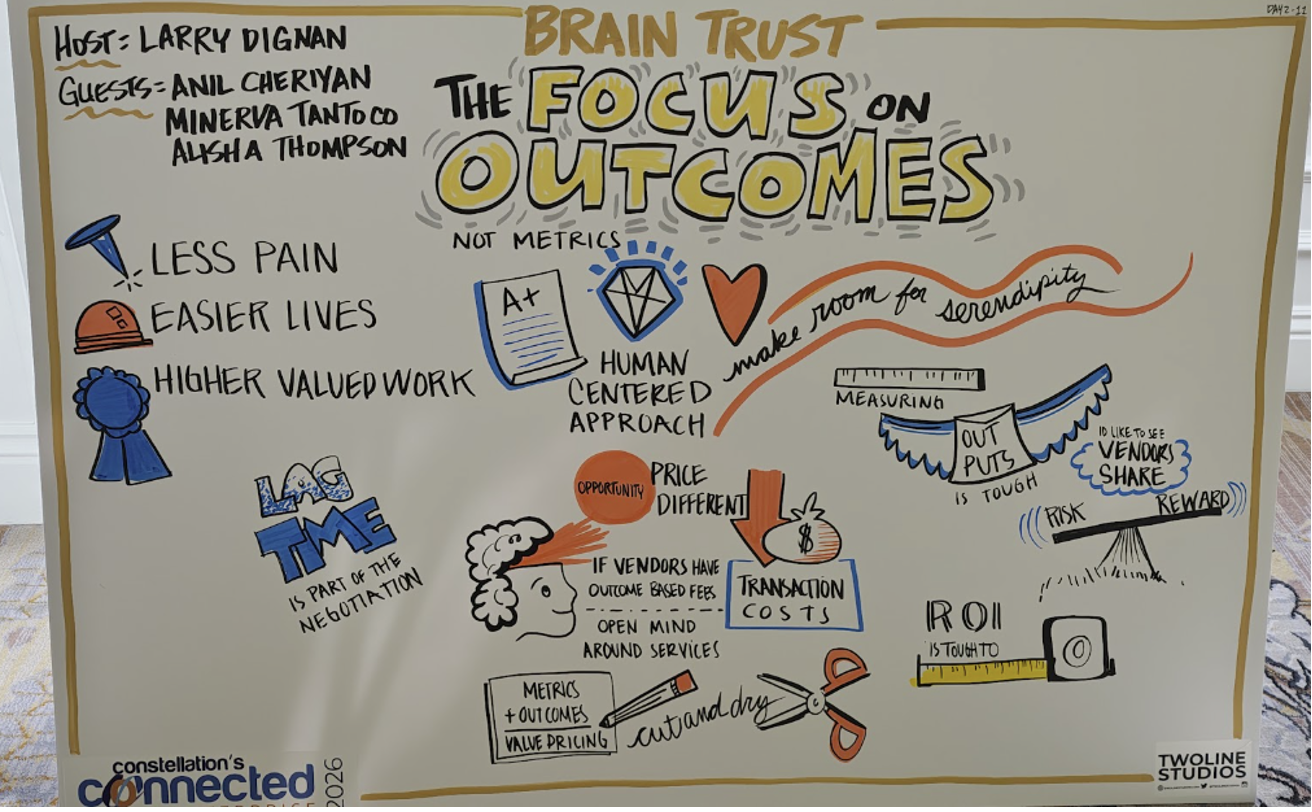
Outcome-based pricing sounds good, but it is hard to put into a contract. However, enterprise buyers are interested in sharing risk with vendors, and the likely end state is a hybrid model that includes a base fee and upside tied to outcomes and milestones. I moderated a panel on outcome-based pricing. Here are the takeaways from Anil Cheriyan, Managing Partner at Phase IV Ventures; Minerva Tantoco, CTO at City Strategies LLC; and Alisha Thompson, CTO at Team Air Distributing. | | | | The lessons learned include: - Don’t confuse metrics for outcomes.
- Leave room for benefits you didn’t plan for.
- Pricing for outcomes is hard.
- Services firms may be the best fit for outcome-based pricing
- Keep an open mind.
- Procurement is the biggest barrier.
"I think it all comes down to the deal and how much skin they have in the game, what exactly we determine as a success metric, how much risk that we both have, and it would have to be on paper. We would both have to be sharing the risk,” said Thompson. “Just because we haven't seen it before doesn't mean that it couldn't be beneficial for us, depending on the type of deal, the type of services." My take: Outcome-based pricing will happen, but it’ll take time. The industry almost needs an observability layer for AI value.
Get ready to wrangle zombie agents and governance
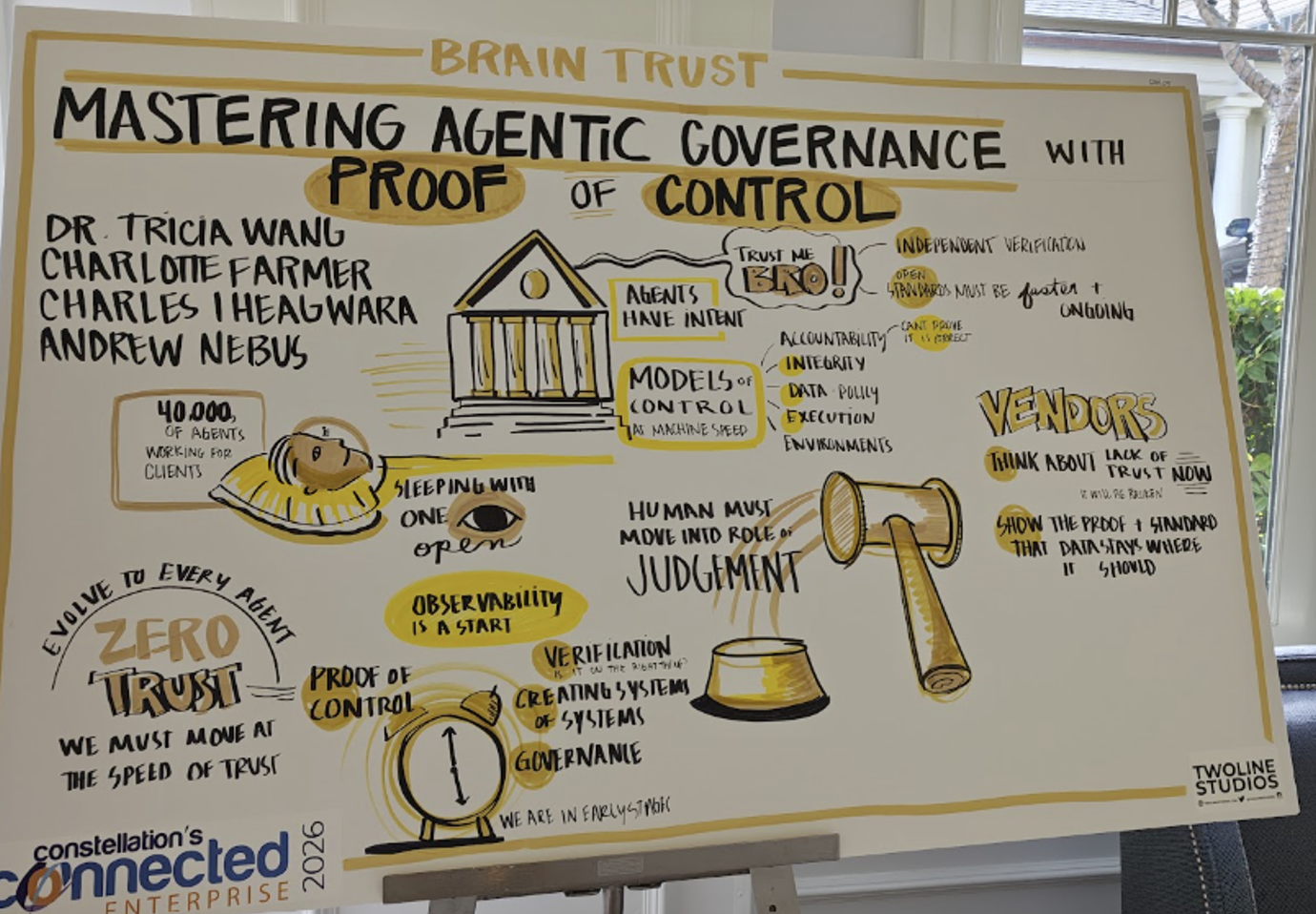
Governance is a big theme in 2027, and your biggest chore is going to be putting zombie agents down.
Boomi CEO Steve Lucas said: "I would be concerned about the zombie agents running in your organization. I'd be very concerned about the AI that shouldn't be accessing a data source."
Brodeur-Urbas of Gumloop said:
"The most common issue we see at all of our customers is they know that agents can do like 90% of the work they want them to do, but IT is saying no at every corner. There are 100 reasons for IT to say no. Like they actually lose their job if something goes wrong. So I don't blame them at all, but they need to make sure that everything is set up so that the data lives in the right place, goes to the right people, and is used for the right reasons. There are 1,000 different governance, observability, and security features. You need to be able to make agents work in the workplace, but focus on the boring side of AI."
Runtime monitoring, clear accountability, restricted access, and verifiable controls were common themes across CCE 2026.
My take: We're going to spend 2027 playing AI agent Whac-A-Mole. | | | | Talent will be organized in pods
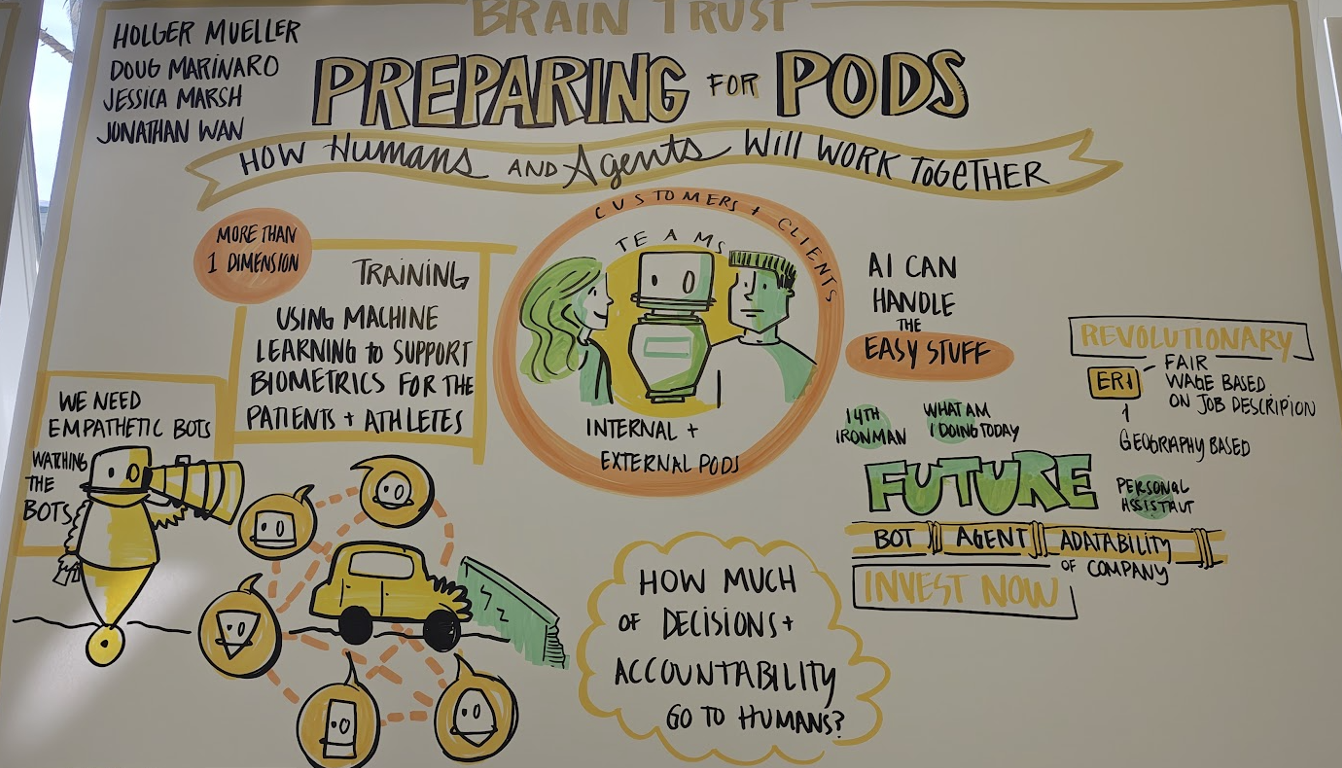
Team structures need to adapt as AI agents and humans increasingly work together in smaller structures, or pods. A pod is a hybrid team of humans and AI that will also include people outside of the company.
At CCE 2026, teamwork was a core theme. How will humans work with AI agents, and what structures will be needed to produce exponential AI outcomes? Here's a look at the themes that'll impact the future of teamwork. - Organizations will need to reorganize into smaller teams.
- The hard design issue will be the handoffs.
- AI adds time but has to be additive.
- Compensation will be an issue.
- Culture between humans and AI agents.
My take: It’s hard to imagine a company maintaining culture over time when AI agents and automation will make up the majority of an enterprise. | | | | The future of LLMs may leave you out
Lucas made a comment worth filing in your back pocket. "I think we've seen the last of these very advanced AI companies giving us their best models," said Lucas. The argument: Why would frontier AI labs sell their competitive advantage when they could use those models for new revenue streams? Think biotech. Keep that mention in mind when you see headlines from Anthropic touting how it is using its models for life sciences and drug discovery.
Models may be hitting their peak. Danenberg said model gains are leveling off. "The difference between an LLM number like 5 and 5.5 is not really a huge step function," he said.
Danenberg reiterated an unpopular view that there may need to be an LLM architecture that goes beyond transformers. "The models are a little bit saturated," said Danenberg. "In order to see the next step function, we have to figure out what's after transformers."
One thought from Lucidity CEO Divya Chander, MD, PhD. is that "wetware" and biology may be the answer. She said the brain's energy efficiency could model future AI. "The brain operates on about 20 watts, which is a dim light bulb. Think of the data centers and all the energy that they take," she said. "Future foundation models originally were based on neurons, integrate and fire, but now they're going to be based on some of the more efficient modes of compute that brains offer us."
Until then, panelists argued that open models will be critical for the enterprise and may win out. Why? Open models enable enterprises to control their data destiny.
My take: The US open model ecosystem needs to be built out beyond Nvidia Nemotron. If I were Google, I'd launch open Gemma models at a much faster clip. Gemini is the focus, but Google should have an open model cadence that rivals what the Chinese labs are doing. | | | | Notebook
📒 For the latest on AWS earnings, more from CCE 2026 and Google Public Sector, see Insights and Notebook.
🛍️ DoorDash said it will buy Instacart for $17 billion.
📈 Alphabet said Google Cloud revenue surged 103% to $30.7 billion with strong demand across AI workloads and TPU systems. Google rolls out Gemini 4 Carbon.
⚠️ If you get bit in the butt from buying shares of Anthropic's IPO you can't say the company didn't warn you about the risks. The company spent 94 pages outlining the risks and said, "it is very dangerous when people buy your company's stock based on expectations you cannot fulfill or incorrect predictions about how you will behave."
🔌 ServiceNow's third quarter was mixed, but the company said demand for AI Control Tower is strong.
👍 Microsoft reported better-than-expected first-quarter earnings, with Microsoft Cloud revenue at $63.9 billion, up 30% from a year ago.
📊 Zoho revamped Zoho Analytics with business context, including ontology and semantics, AI agents that specialize in analytics, governance, and a unified platform that operates headless and extends into other applications.
🌊 The National Oceanic and Atmospheric Administration is betting that moving to the cloud, along with a healthy dose of artificial intelligence, will let it distribute its weather and forecasting data faster. First, NOAA is looking to wrangle data, speed up research, and process information wherever it is stored.
💲Broadcom said it has raised $63 billion in financing for AI infrastructure for Anthropic. The financing will fund the purchase of Broadcom XPU AI accelerators.
✨ Verizon CEO Dan Schulman weighed in on potential competition from SpaceX's Starlink and said satellite mobile service will become a reality, but it'll take about $300 billion to $500 billion and 7 to 8 years to build a terrestrial network. Today, the story revolves around Starlink entering the mobile market. Tomorrow, the story will revolve around the last mile of AI workloads.
🚀 Intuit launched industry-focused versions of its Intuit Enterprise Suite, automated revenue management via its Sequence acquisition, a context layer powered by Intuit Intelligence and a financial command center.
🫱🏽🫲🏾 Intel said it will buy quantum computing software company Classiq as the chip maker aims to become a quantum computing player.
🪙 Amazon told its software developers that measuring tokens is a deeply flawed metric and that they should focus on being curious, getting close to the customer and delivering outcomes. | | | |
Insights Archive CIOs will need to navigate the nuance for enterprise AI vendors What we can learn from industrial, blue-collar AI Data ontology: A kinder, gentler form of lock-in The great enterprise AI rewrite is starting Enterprise AI projects mature: What you need to know now Nvidia’s Nemotron hit enterprise AI inflection point Salesforce still has pricing work to do Why you should arbitrage your AI models like your vendors do Quantum computing: Where we stand in 2026 SaaS: Apocalypse over, sorting winners and losers just starting Why AI infrastructure folks are talking so much about applications AI value metrics and vendors need better pricing models Enterprise AI grows up, vendors are noticing How UnitedHealth Group sets its AI stack, targets 1,000 use cases Enterprise vendor pecking order will be upended by volatility, AI inflection points Here’s what we learned about AI projects from enterprise buyers so far Here’s what we learned about AI projects from enterprise buyers so far Don't let your vendor's AI strategy become yours For Starbucks, AI returns are behind the scenes What if our AI infrastructure is already built? How to avoid vendor lock-in in the AI age AI inference costs will be a major concern: What's the fix? How Prudential CTO Liz Brand is approaching agentic AI, transformation The private preview plague Google Cloud, AWS, Microsoft Azure: The AI vertical integration race How Verizon manages AI agent sprawl The space race and what it means for enterprises Google Cloud Next 2026: A look at the big themes Your AI talent planning algorithm is common sense Zillow bets on content, context, data flywheel as AI differentiator AI Forum 2026: There isn’t an easy button for AI Constellation Research's Futures Forum: What CEOs are thinking Where’s tokenomics for the rest of us?
Disruption coming for ERP and not from where you'd think
Anthropic vs. SaaS: A nuanced view
Zoho Day 2026 themes to watch: ERP, SaaS, customer value, AI, sovereignty
How three hotel giants are playing agentic commerce, AI
SaaS under the microscope: How to evaluate your vendor Forward-deployed engineers: The promise, peril in AI deployments Caterpillar’s AI Vision Takes Shape, but Data, Cloud Focus Was the Precursor Agentic AI experiences will determine enterprise winners Why enterprise AI leaders need to bank on open-source LLMs -
Enterprise technology 2026: 15 AI, SaaS, data, business trends to watch
| | | | | | | | | | | | | |