Print Icon
 

February 21, 2026

Zoho Day 2026 featured dozens of takeaways and insights from an enterprise software company that has historically been disruptive with great value for the money. And AI is likely to push the SaaS hunger games more in its favor.  


While we could riff on Zoho-specific takeaways, it’s worth highlighting the themes that apply to the broader enterprise software sector, including buyers and vendors.  

Here’s a look.  


ERP is back.
 Zoho launched 
an ERP platform in 
India in January, and plans to launch in other countries in the near future. Think the US. If you couple Zoho ERP with what Intuit is doing in ERP with the Intuit Enterprise Suite, there's nothing but good news ahead for midmarket enterprises. What'll be interesting to watch is how Zoho and Intuit creep up to larger enterprises.  


Siva Iswaran, Global Head of Finance and Operations and CEO of Zoho Payment Technologies, said the ERP strategy revolves around a country-specific approach, followed by expansion. The company is targeting manufacturing, retail, distribution, and nonprofits as its initial markets.  

"We are seeing excellent traction in India and customers who want to move from their legacy systems such as SAP and Microsoft Dynamics," said Iswaran, who noted that Zoho's strategy is to provide an integrated platform that serves as a digital nervous system for the enterprise. Zoho is also adding its know-how on Unified Payments Interface and similar digital infrastructure to its ERP flows. 


The ERP-fest had me humming Eminem. 


Guess who's back, back again? 

ERP's back, tell a friend 

Guess who's back, guess who's back 

Guess who's back, guess who's back 

Guess who's back, guess who's back 

Guess who's back 

(Na-na-na, na, na, na, na, na, na) 

(Na-na-na, na, na, na, na) 


My take: Systems of record appear to be the most defensible layer of SaaS so it’s not surprising that ERP is in favor again. This ERP scrum in the midmarket will be fun to watch. Expect some large vendor disruption from below.  


ERP is back because the mundane suddenly matters again. Vijay Sundaram, Chief Strategy Officer at Zoho, said during his talk that systems of record and APIs are what make AI work, along with data. "Your system of record and your APIs and all that kind of infrastructure layer that vendors had now become strategic assets. Because a lot of the layers of AI and technology depend on it, and all of a sudden, you can see that there is some sort of magnificence in what was mundane," said Sundaram. 


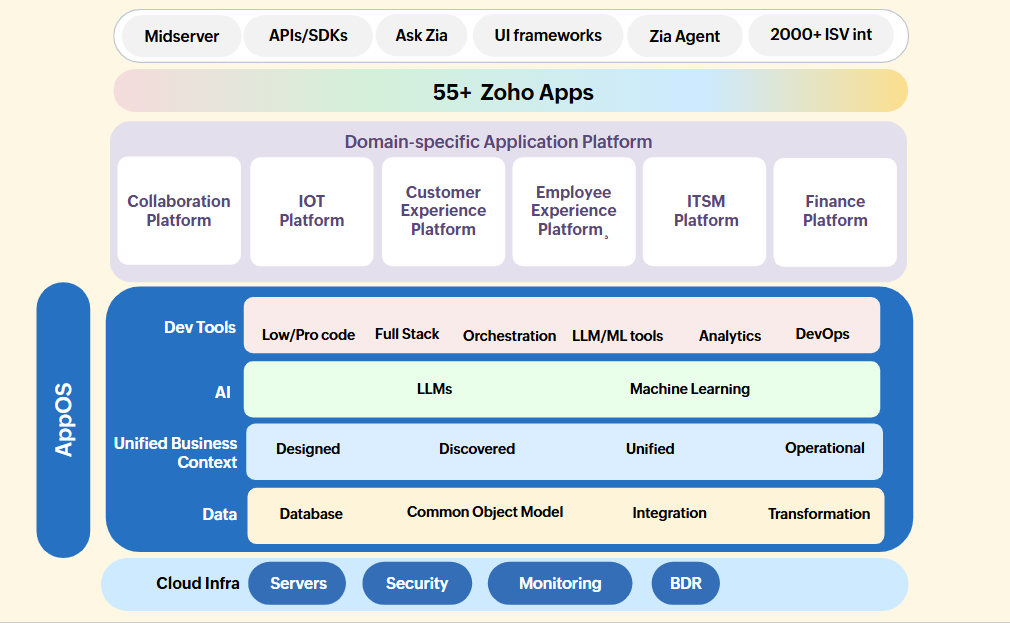
My take: AppOS is an interesting development and on target for the moment. Think of AppOS as an architecture more than a product.  

The most jarring thing about AI is that we've gone from digitizing things to digitizing ourselves. Zoho's bet is that productivity is shifting from digitizing around us to intelligence. And that means outcomes. 


My take: This digitization of intelligence and, therefore, humans is what spurs concerns about future jobs.  


Don't be confused by the current pricing of premier LLMs because they'll be extracting profits sooner than you'd think. "The investment phase will transition to the extraction phase soon," said Raju Vegesna, Chief Evangelist at Zoho. "We should not be fooled by the current economics of the public models by some companies. We've seen this movie too many times where companies invest, keep the product cheap, and grow share. Then they flip the switch, and you're in the extraction phase, and you keep paying the extraction tax." 


My take: The open-source model argument is preaching to the choir from this perch. To think about open-source models, you need two characteristics: the ability to think globally, since non-US companies are driving open-source adoption, and the willingness to procure talent to customize. AWS’ Nova Forge effort may thread the needle for enterprises.  


Own your models. Zoho is extremely wary of proprietary model providers and believes open-source models will do to AI what Linux did to software. The core theme from executives revolved around focused, private, and efficient models. Focused models trained on live contextual data often outperform large, generic models for business use cases.  


"We also have to own the models,” said Vegesna. "Owning those models allows us to custom-train and custom-deploy based on custom requirements." 


My take: Own your models is good advice.  


Build a foundation. With Zoho's preview of AppOS, it's clear the company is focusing on a foundation that can scale applications, including efforts produced by AI. Zoho Labs Director Ramprakash Ramamoorthy said the company has built its own database stack and models optimized for its enterprise. Those investments are all about context.  


"We've been talking about Zoho's AI strategy for years. We talked about two things, one is right-sizing models, and the other is finding the right context," said Ramamoorthy. "The basics matter more. Can you have a vector database that really supports your AI workloads very well? Can you optimize your AI models to work on CPUs wherever possible and bring in the GPUs only when you need them?" 

Zoho CEO Mani Vembu said the future of AI-driven apps and SaaS will boil down to platforms. 


"Nobody has had the time to solve the fundamental foundation," said Vembu. "This is the current state of enterprise software. There is a broken foundation, and then the thing built on top of it." 


My take: You should consider future-proofing your architecture to give yourself options. And you should watch your AI costs. Nobody is talking about AI efficiency and economics today, but they will. 


SaaS margins are going to be squeezed, possibly crushed. A recurring theme among Zoho executives was that AI will compress profit margins. Zoho Chief Scientist Sridhar Vembu said, "Software has to be more affordable."  


"There's no reason to charge a huge amount for simple things anymore. Zoho is probably most adaptable since we offer more. Clearly, customers are going to demand more value," he said. "Expect more value from your vendors, including Zoho." 

My take: Zoho is already a SaaS margin wrecking ball. SaaS margins are Zoho’s opportunity. 


Sovereignty matters. If someone can pull the plug on one of your systems, are you really sovereign? That question is frequently asked by Zoho's globally diverse customer base. As a result, Zoho is building a vertically integrated stack of hardware and software. Zoho is also offering multiple deployment models to allay sovereignty concerns.  


My take: Every enterprise vendor will need a sovereignty story. 


Customer satisfaction is your business moat. It sounds relatively obvious, but focusing on customers and delivering value will be the differentiator amid AI upheaval. "At end of the day, human-to-human relations matter the most, and that is where we are investing," said Vegesna. "Customer satisfaction is the ultimate moat." 

Zoho Chief Scientist Vembu put that human interaction theme in the context of adapting to new job roles. "Your people skills are more valuable than broad technical skills. I think that is where we might be heading. Get closer to the customer," said Vembu. "I see our customer support. They've become valuable because we can pick up and talk to real humans. We use AI to give them better solutions, faster solutions, and more accurate solutions, but there is a human talking. People think of customer support first." 


My take: Being more human with customers will be the differentiator. The same small subset of companies that excel at customer experience will get the memo. Most companies won’t.  


NOTEBOOK


🗒️ For the latest, see Constellation Insights and my live Notebook. 

📢 The Q1 2026 Constellation ShortList™ portfolio updates are here, with 43 new and refreshed categories that reflect where enterprise technology investment is accelerating right now. 

💪🏽 Quantinuum is seeing strong demand for its new Helios quantum computer and is hitting an inflection point as businesses prepare for real-world use cases, according to Honeywell CEO Vimal Kapur. 

♻️ Microsoft Research outlined Project Silica, an effort to use glass storage to preserve data for up to 10,000 years. Microsoft said: "Glass storage is still emerging (experts predict it will require 3-4 more developmental stages before it’s ready for commercial use), but its benefits are clear: it’s durable, sustainable, and cost-effective." The project was published in Nature. 

 📚 Meta to double down on Nvidia's AI stack, including CPUs. Meta will buy millions of Nvidia CPUs and GPUs.  

👾 Anthropic launched Claude Sonnet 4.6, which is an upgrade that improves coding skills, computer use, agent planning, and knowledge work. 

🔒 Palo Alto Networks said it will acquire Koi, adding endpoint security to AI agents. The company also reported a strong quarter. 

🛜 Quantum computing software company Classiq, Comcast, and AMD announced a trial that leverages quantum algorithms to improve network routing and resilience. 

🛍️ Etsy has sold Depop, a Gen-Z thrifting marketplace, to eBay for $1.2 billion. Etsy acquired Depop in 2021 for $1.6 billion. 

📈 Figma reported better-than-expected earnings, delivered a strong outlook, and something rare happened — the stock went up. 

🫱🏽‍🫲🏾 Mistral AI will acquire cloud provider Koyeb in a move to accelerate its Mistral Compute service. 


💪🏽 Two AI-powered retailers, Walmart and Wayfair, reported strong results.  

🎙️ The Royal Society Michael Faraday Prize Lecture was delivered by the 2025 winner, Professor Michael John Wooldridge. The talk is worth a listen. Wooldridge argues that intense commercial pressure is forcing tech companies to release tools before their flaws are understood. He suggests that a high-profile failure—such as a deadly self-driving car update or an AI-powered financial collapse—could shatter global trust in technology, much like the Hindenburg disaster ended the era of airships. 
     

Like getting our weekly round-up? Subscribe to Constellation Insights for consistent news and analysis on technology trends, earnings, enterprise updates and more.

Want to work with Constellation analysts? Our Sales team would love to get in touch!

You are receiving this email as you signed up for our newsletters.

Want to change how you receive these emails?

You can Unsubscribe or Update your preferences